



1. Introduction
If you have ever stood in front of a window holding a curtain panel, unsure whether to let it graze the floor or keep it hovering above, you are not alone. This is one of the most common dilemmas in home decorating, and it comes up again and again because there is no single rule that fits every room.
This guide covers everything you need to know about curtain length, starting with the simple question that brings most people here in the first place, should curtains touch the floor, and expanding into every related detail, from measuring techniques to room-specific advice.
Curtain length matters far more than most people realize when they first start decorating a space. A curtain that is too short can make an entire room look unfinished, almost as if the windows were dressed in clothes a size too small. On the other hand, curtains that are far too long can look messy, collect dust, and become a tripping hazard.
The length of your curtains affects the overall proportions of the room, the way light and privacy are managed, and even how tall or spacious a space feels. Getting it right is a small detail that makes a surprisingly large visual difference, which is exactly why this guide exists.
2. The Short Answer
For those who want a quick verdict before diving into the details, yes, in most cases curtains should touch the floor. Whether they barely kiss the floor, float just above it, or puddle generously across it, having curtains reach close to floor level generally creates a more polished, deliberate, and visually balanced look than curtains that stop short partway down the wall. This is the standard recommendation given by most interior designers, and it holds true across a wide range of room styles and window types.
That said, there are situations where shorter curtains are actually the better choice. Café-style curtains that only cover the lower half of a window, or curtains hung above a radiator, window seat, or piece of furniture that sits directly beneath the window, often work best when they stop at a specific point rather than reaching the floor.
Similarly, in rooms with heavy foot traffic, pets, or small children, a slightly shorter length that floats just above the floor can be more practical than one that touches down. In contrast, longer curtains that puddle onto the floor work beautifully in formal spaces where drama and elegance take priority over convenience. The right choice always depends on the room’s function, the amount of use it gets, and the mood you are trying to create.
3. The Main Curtain Length Styles
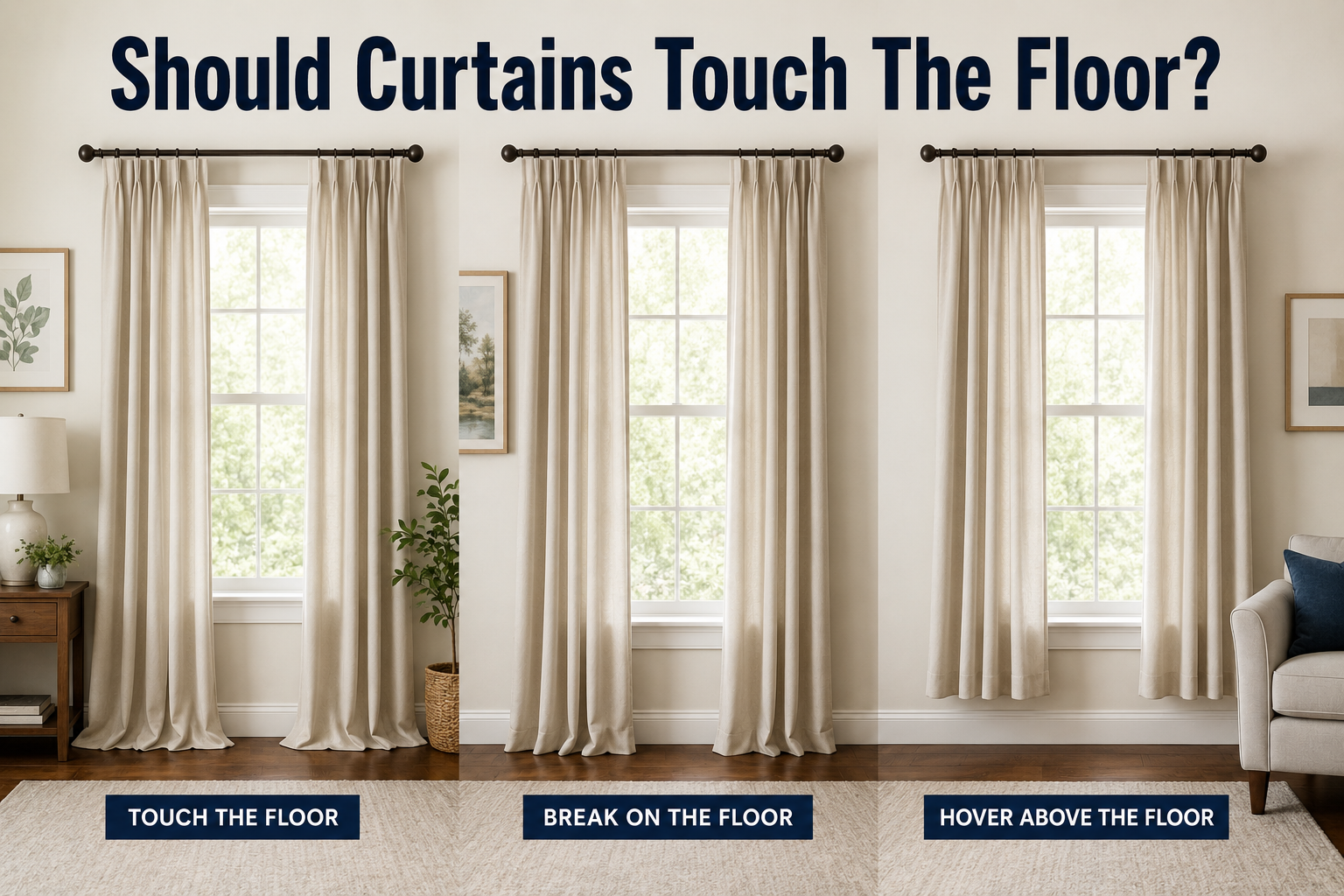
One of the biggest questions people ask when hanging new drapes is, should curtains touch the floor, and the honest answer is that it depends on the look you want to create. Interior designers generally group curtain lengths into four main styles, and each one gives a room a slightly different mood.
Understanding these styles before you buy or hem your curtains will save you time, money, and the disappointment of curtains that just don’t look right once they’re hung.
Floating (Above the Floor)
Floating curtains hang about half an inch to one inch above the floor. This style keeps the fabric visibly separated from the ground, giving the window a clean, tidy, and almost tailored appearance. It is one of the most practical choices because the curtains never drag on the floor, which means they stay cleaner for longer and are far less likely to get caught under furniture, pets, or foot traffic.
This style works particularly well in homes with young children or pets, since there is no loose fabric pooling on the ground for little hands or paws to pull at. It is also a popular pick for kitchens, laundry rooms, and high-traffic hallways, where practicality matters just as much as appearance.
While floating curtains are simple and functional, they can sometimes look slightly casual, so they are best suited to relaxed, everyday spaces rather than formal living rooms.
Kissing the Floor
The “kissing the floor” style is often considered the safest and most universally flattering choice, which is why so many people conclude that curtains should touch the floor in this exact manner.
In this style, the bottom edge of the curtain barely grazes the floor, without any extra fabric bunching up or dragging. It creates a soft, finished look that feels intentional rather than accidental.
This style suits almost any room, from bedrooms to dining rooms to home offices, because it strikes a balance between elegance and practicality.
It is neat enough to look polished, yet it doesn’t create the maintenance challenges that come with longer, puddling fabric. For most homeowners wondering should curtains touch the floor or hover above it, the kissing style is usually the safest middle-ground answer.
Puddle (Extra Fabric Pooling)
Puddle-length curtains extend a few inches beyond the floor, allowing the extra fabric to pool or “puddle” gently at the base of the window. This is the most dramatic and luxurious of the four styles, often seen in high-end hotels, formal dining rooms, and elegant master bedrooms. The soft folds of fabric add a romantic, old-world charm that instantly elevates the feel of a space.
However, puddle curtains require more upkeep than any other style. Because the fabric sits directly on the floor, it collects dust, pet hair, and dirt more quickly, and it needs regular shaking out or vacuuming to stay looking fresh. This style is best reserved for formal rooms with low foot traffic, such as a formal living room or a guest bedroom that isn’t used daily.
Break (Slight Fold, Like Dress Pants)
The break style borrows its name from tailoring, much like how dress pants are hemmed to create a small fold just above the shoe. With curtains, this means the fabric is slightly longer than the floating style but not quite touching the floor evenly, so it creates a soft, gentle fold or crease at the bottom.
This style gives curtains a relaxed yet refined appearance, somewhere between the clean simplicity of floating curtains and the elegance of a full puddle. It works well in living rooms and bedrooms where you want a touch of sophistication without the maintenance demands of puddled fabric.
Quick Comparison Table
| Style | Distance from Floor | Best For | Maintenance Level |
|---|---|---|---|
| Floating | 0.5 to 1 inch above floor | Kitchens, kids’ rooms, high-traffic areas | Low |
| Kissing the Floor | Barely touching, no pooling | Living rooms, bedrooms, most spaces | Low to Medium |
| Puddle | 2 to 6 inches of extra fabric on floor | Formal dining rooms, master bedrooms | High |
| Break | Slight fold, similar to floating but softer | Living rooms, bedrooms wanting subtle elegance | Low to Medium |
4. Pros and Cons of Each Style
Choosing between these four styles becomes much easier once you weigh their individual advantages and drawbacks side by side. Below is a breakdown of what each style does well and where it falls short, along with the situations where it tends to shine.
Floating curtains are easy to live with day to day. Because they hover above the floor, they resist dust buildup, stay away from pets and vacuum cleaners, and rarely need re-adjusting. The downside is that if measured incorrectly, they can look accidentally short rather than intentionally floating, so precision matters. This style is best used in kitchens, bathrooms, laundry rooms, and any space where practicality is the priority.
Kissing the floor curtains offer the best of both worlds: they look elegant without demanding constant upkeep. Their main advantage is versatility, since this length suits nearly every room and works with almost any fabric type. The only real downside is that it requires fairly precise measuring, since even half an inch off can make the curtain look either too short or slightly puddled. This style is ideal for bedrooms, living rooms, dining rooms, and home offices.
Puddle curtains bring unmatched drama and softness to a room, making them a favorite in formal or luxury interiors. Their biggest drawback is maintenance, since the fabric pools directly on the floor and collects dust, hair, and dirt more quickly than other styles. They can also be a tripping hazard in busy households. This style is best reserved for formal living rooms, dining rooms, or guest bedrooms with minimal foot traffic.
Break curtains offer a middle-ground softness without full puddling, giving a subtly elegant fold at the base. The downside is that this style can be harder to achieve consistently, since the exact fold depends on fabric weight and how the curtain is hung. It works particularly well in living rooms and primary bedrooms where a touch of sophistication is wanted without heavy maintenance.
5. Room-by-Room Recommendations
Not every room calls for the same curtain length, and thinking through each space individually will give you a more cohesive, functional home. Here is a practical breakdown of what tends to work best in different rooms.
In the living room, since this is often the most formal and visually prominent space in the house, either the kissing-the-floor style or a soft puddle works beautifully, especially if the room doesn’t see heavy daily foot traffic near the windows.
In the bedroom, curtains that kiss the floor or have a slight break tend to work well, offering a cozy, finished look without being difficult to manage around a bed or nightstand.
In the dining room, this is one of the best rooms for a puddle-style curtain, since dining rooms are typically used for shorter periods and benefit from a more elegant, formal appearance.
In the kitchen, floating curtains are the most practical choice here, since kitchens involve spills, foot traffic, and frequent cleaning, all of which make floor-length fabric inconvenient.
In the bathroom, similar to kitchens, bathrooms benefit from shorter or floating curtains due to moisture, humidity, and limited space, which can cause floor-length fabric to mildew or feel cramped.
In kids’ rooms, floating curtains are strongly recommended for safety and practicality, since children are more likely to pull on, trip over, or make a mess of curtains that reach the floor.
In the home office, a kissing-the-floor length usually works best, offering a professional, polished appearance for video calls and everyday work without unnecessary fabric bulk.
Room Recommendation Summary
| Room | Recommended Style | Why |
|---|---|---|
| Living Room | Kissing floor or Puddle | Formal, low daily traffic near windows |
| Bedroom | Kissing floor or Break | Cozy and finished, easy to manage |
| Dining Room | Puddle | Elegant, used for shorter periods |
| Kitchen | Floating | Practical, spill and traffic prone |
| Bathroom | Floating or shorter | Moisture and space concerns |
| Kids’ Room | Floating | Safety and easy maintenance |
| Home Office | Kissing floor | Polished, professional appearance |
6. Factors That Influence the Right Length
Beyond personal taste, several practical factors should guide your decision on curtain length. Ceiling height plays a major role, since rooms with high ceilings can often handle the drama of puddled curtains, while rooms with lower ceilings may look better with a cleaner, floating or kissing-the-floor style that doesn’t visually shorten the space further.
Window size and placement also matter significantly. A large window that spans most of a wall can support longer, more dramatic curtains, while a small window may look overwhelmed by too much extra fabric pooling around it.
Flooring type is another important consideration. Curtains puddling onto plush carpet can look soft and luxurious, but the same length on hardwood or tile floors may show dust and dirt far more visibly, requiring more frequent cleaning.
Foot traffic, along with the presence of pets or small children, should heavily influence your choice. High-traffic areas or homes with active pets and kids generally do better with floating or break-style curtains that avoid contact with the floor altogether.
Curtain fabric weight changes how a length behaves in practice. Heavier fabrics like velvet naturally puddle and fold more elegantly, while lightweight fabrics like linen or sheer voile tend to look better with a cleaner floating or kissing length, since they don’t hold a puddle shape as well.
Finally, whether your decor style is formal or casual should guide the overall decision. Formal spaces lean toward puddle or break styles, while casual, everyday spaces generally look better and function more efficiently with floating or kissing-the-floor curtains.
7. How to Measure Curtains Correctly
Getting the length right starts with accurate measuring, and having the right tools makes this process far easier. You will need a steel measuring tape rather than a fabric one for accuracy, a step ladder to reach the curtain rod comfortably, a pencil and notepad to record measurements, and, if possible, a second person to help hold the tape steady at the top of the window.
To measure correctly, follow these steps in order. First, install your curtain rod at the height you plan to use, since measuring before the rod is up can lead to inaccurate results. Second, hook the measuring tape at the top of the rod, exactly where the curtain rings or hooks will sit. Third, pull the tape straight down to the floor, keeping it as vertical and taut as possible to avoid sagging that throws off the number.
Fourth, decide which style you want, floating, kissing, break, or puddle, and adjust your final number accordingly, for example subtracting half an inch for a floating look or adding a few inches for a puddle. Fifth, measure at both the left and right sides of the window, since floors and ceilings are not always perfectly level, and use the shorter measurement if there’s a discrepancy to avoid curtains that drag unevenly.
Common measuring mistakes include measuring before the rod is installed, using a soft fabric tape that stretches and gives inaccurate readings, forgetting to account for the curtain rings or clips that add extra height, and measuring only one side of the window instead of both. Avoiding these simple errors will save you from ordering or hemming curtains that end up the wrong length.
8. Curtain Rod Height and Placement Tips
The height at which you mount your curtain rod has a surprisingly large effect on how the finished curtains look, even more so than many people expect. Mounting the rod higher than the actual window frame, rather than directly above it, creates an illusion of a taller window and, by extension, a taller ceiling. This is one of the simplest tricks used by interior designers to make a room feel more spacious.
As a general guideline, placing the rod about four to six inches above the window frame, or roughly two-thirds of the way between the top of the window and the ceiling, tends to give the most flattering result. In rooms with lower ceilings, mounting the rod as close to the ceiling as possible maximizes the illusion of height.
The width of the rod matters too, extending it several inches beyond each side of the window frame allows the curtains to be pulled fully open during the day, letting in maximum light while still providing full coverage at night.
9. Common Mistakes to Avoid
Even with the best intentions, certain curtain mistakes show up again and again in homes, and being aware of them can help you avoid an unpolished result. Curtains that are too short, sometimes referred to as “floods” because they resemble pants that are too short, are one of the most common and most noticeable errors. This happens when curtains stop well above the floor without any clear stylistic intention, making the window look undersized and the entire wall appear unfinished.
Uneven hemming is another frequent issue, often caused by measuring only one side of a window or by fabric that shifts during installation. This results in curtains that drag on one side while floating on the other, creating a lopsided, unintentional appearance.
Using the wrong fabric weight for your chosen style can also cause problems, for instance attempting a puddle effect with a stiff, lightweight fabric that won’t fold naturally, or trying to achieve a crisp floating look with a heavy fabric that sags and loses its shape over time.
10. Fixing Curtains That Are the Wrong Length
If you already own curtains that are the wrong length, there are several ways to fix the problem without necessarily buying new ones. Hemming is the most permanent and professional solution, and you can either sew a new hem yourself if you’re comfortable with basic sewing, or take the curtains to a tailor or alterations shop for a clean, precise finish.
For those who need a quicker fix, no-sew options are widely available and surprisingly effective. Fusible hem tape, which uses heat from an iron to bond fabric together, and fabric glue both allow you to shorten or adjust curtains without any stitching at all. These methods work particularly well for temporary fixes or for those without sewing experience.
Knowing when to buy new panels instead of altering existing ones is also worth considering. If your curtains are significantly too short with no extra fabric to let out, or if the fabric is worn, faded, or damaged, purchasing new panels in the correct length is often more cost-effective and produces a better final result than attempting to alter curtains that don’t have enough material to work with.
11. Style Tips from Interior Designers
Professional interior designers consistently emphasize a few key principles when it comes to curtain length. Many designers agree that when in doubt, curtains should touch the floor rather than stop short, since floor-grazing or slightly puddled curtains almost always look more intentional and finished than curtains that end mid-wall. This preference shows up repeatedly in professionally styled homes, showrooms, and design portfolios.
In terms of trends, there has been a noticeable shift toward the kissing-the-floor and subtle break styles in recent years, particularly in modern and minimalist interiors, as homeowners look for a balance between elegant appearance and everyday practicality. At the same time, the puddle style remains a beloved classic in traditional, formal, and luxury interior design, especially in dining rooms and primary bedrooms where a touch of old-world glamour is welcome.
12. Conclusion
Choosing the right curtain length comes down to understanding your room’s function, your household’s lifestyle, and the overall style you want to achieve. Throughout this guide, the recurring theme has been clear: in most cases, curtains should touch the floor in some form, whether that means a barely-there kiss, a soft puddle, a subtle break, or a clean float just above the ground. Each style carries its own advantages, ideal use cases, and maintenance considerations, so the best choice truly depends on the specific room and how it’s used.
Before making your final decision, it helps to run through a simple checklist. Consider the room’s purpose and how much foot traffic it gets, think about whether pets or small children will be around the curtains regularly, factor in your flooring type and how easily it shows dust, choose a fabric weight that supports your desired style, and always measure carefully on both sides of the window before cutting or hemming. With these factors in mind, you’ll be well equipped to choose curtain lengths that not only look beautiful but also function well in your everyday life.
Related Aricles
How to Clean Mold from Bathroom Ceiling: Complete Step-by-Step Guide
How To Clean Cork Flooring? A Complete Step-by-Step Guide
How to Cover Up Popcorn Ceiling: 6 Easy Methods for a Modern Look
Can You Paint a Metal Roof? The Complete Answer Homeowners Need
How To Restain Kitchen Cabinets? Step-By-Step Guide For Beginners