


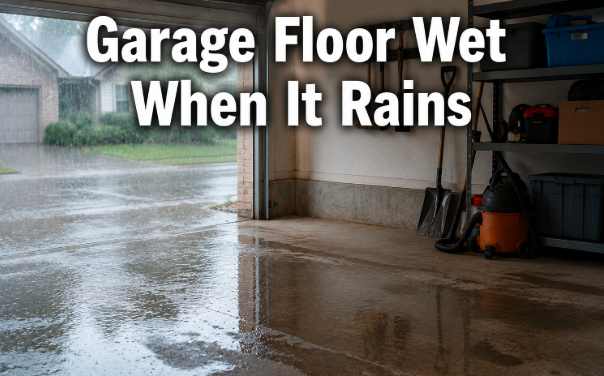
A wet garage floor after rain almost always comes down to one of four things: water tracking in under the door, cracks letting rain through the walls or slab, groundwater pushing up from below, or condensation forming on a floor that’s colder than the air around it. Three of those are water finding a way in. The fourth isn’t a leak at all. It’s the same thing that fogs up a cold glass of iced tea on a muggy day.
Which one you’re dealing with changes the fix completely. Sealing the floor helps with condensation but does nothing for water pouring in under a bad door seal. A new vapor barrier is a waste of money if your gutters are dumping water at the foundation instead. Each cause leaves its own clues, so a few minutes of checking during or right after a rainstorm usually tells you exactly which problem you have.
Is it a leak or condensation? Run this quick test first
Before you fix anything, find out whether the water is arriving from above, rising from below, or forming out of thin air on a cold surface. This one check saves the most wasted effort and money.
- Watch the base of the door during a storm. If water appears right at the bottom of the door, it’s coming in from outside, not condensing.
- Tape a piece of clear plastic sheeting, about one foot square, tightly to a dry patch of concrete and leave it for 24 hours.
- Peel back the plastic and check both sides. Water sitting on top of the plastic means it’s coming from above or the sides. Dampness on the concrete underneath, with the top of the plastic still dry, points to moisture rising from below or condensing against the cold slab.
If the wet patches dry out fast once you open the garage door and let air move through, condensation is the likely culprit. A true leak tends to keep producing fresh water for as long as it rains, no matter how much air you move.
Water tracking in under the garage door
The most common reason a garage floor gets wet during rain is water sneaking in under the bottom of the door. This usually traces back to one of two things: a worn-out bottom seal, or a driveway apron that slopes toward the garage instead of away from it.
Check the rubber seal along the bottom edge of the door. Over time it cracks, flattens, or pulls loose, and once that happens it can no longer block water the way it did when new. If the seal looks fine but water still gets in, look at the slope of the concrete just outside the door. A driveway that tips even slightly toward the garage will funnel rainwater straight onto the slab, often leaving a fan-shaped puddle just inside the threshold.
The fix for a worn seal is straightforward: replace it, a job most people can do in under an hour with a new bottom seal from a hardware store. If the slope is the problem, a threshold seal (a raised strip that runs across the base of the doorway) can hold back shallow water, though a driveway with a real negative slope may eventually need to be reworked by a concrete contractor.
Water coming through wall or floor cracks
Rain can also work its way through cracks in the garage walls or in the slab itself, particularly on the side of the building that takes the brunt of wind-driven rain. Unlike water under the door, this shows up as damp or wet patches on the wall surface itself while it’s actively raining, not just at floor level.
Hairline cracks are common in poured concrete and concrete block, and they widen slightly with age, temperature swings, and settling. Walk the inside perimeter of the garage during a storm and look for water tracking down from a specific spot on the wall. That’s usually the exact location of the crack, even if you can’t see it clearly from indoors.
The fix is to seal the crack from the outside with a flexible, exterior-grade filler or hydraulic cement, then apply a masonry waterproofing coating over the surrounding area. Sealing only from the inside tends to trap water in the wall itself rather than keeping it out, which can make the problem worse over time.
Water rising up through the slab
Sometimes a garage floor stays damp even when nothing is obviously leaking through a door or wall. If the dampness shows up in dry weather too, not just after rain, the water is likely rising up through the concrete itself.
This happens because concrete is porous, and the ground beneath a slab always holds some moisture. During and after heavy rain, saturated soil creates extra pressure (called hydrostatic pressure) that pushes water upward through the concrete, especially if the slab was poured without a vapor barrier underneath it.
Older garages are the most common ones affected, since a plastic vapor barrier under the slab wasn’t standard practice on every job decades ago. One telltale sign is efflorescence: a white, powdery mineral residue left behind once the water evaporates from the surface.
Fixing rising groundwater usually means addressing the water table around the foundation rather than just the slab. Exterior perimeter drains or an interior drainage system connected to a sump pump can lower the amount of water sitting against the foundation. For less severe cases, a penetrating concrete sealer or a damp-proofing coating applied to the slab surface can meaningfully cut how much moisture makes it through.
In the most stubborn cases, the only lasting fix is removing the slab and repouring it with a proper vapor barrier underneath, or adding a vapor barrier plus a new layer of concrete on top of the existing floor.
Why the floor sweats even when nothing is leaking?
Condensation, sometimes called a sweating slab, is the one cause on this list that has nothing to do with water getting in from anywhere. It’s a temperature problem, not a water intrusion problem.
Concrete has a lot of thermal mass, meaning it holds onto its temperature far longer than the air around it. In spring and fall especially, a rainstorm can bring in a wave of warm, humid air while the garage floor is still cool from the days before.
When that humid air touches the colder concrete, the moisture in it condenses into liquid water right on the surface, the same way water beads up on the outside of a cold drink. The point at which air is holding all the moisture it can, and starts giving it up as liquid, is called the dew point; once a surface drops to or below that temperature, condensation follows.
A sweating floor usually looks patchy rather than uniformly wet, tends to be worse near exterior walls, and dries out relatively quickly once the garage warms up or gets some airflow. Poor ventilation makes it worse, since stale, humid air just sits against the cold slab instead of mixing with drier air from outside.
A few things cut down on condensation. Sealing the floor slightly raises its surface temperature and reduces the porosity that makes moisture visible on it. Opening the garage door for a while after a storm, running a fan, or adding a small dehumidifier all help the air dry out faster.
For a home overall, the EPA recommends keeping indoor relative humidity between 30 and 50 percent to keep mold from taking hold, and an attached garage benefits from the same target, especially if it shares any airflow with the rest of the house.
Grading and gutters that aim water at the garage
Sometimes the water causing the problem never even reaches the door or the walls directly. It pools around the foundation first, then finds its way in through the path of least resistance.
Ground or a driveway that slopes toward the garage instead of away from it channels every rainstorm straight at the building. Gutters and downspouts play a similar role. When a gutter is clogged or a downspout ends right next to the foundation instead of routing water several feet away, that water lands right where you don’t want it, and some of it ends up on the garage floor.
Fixing this usually costs less than the other repairs on this list. Regrading a small section of ground or an apron so it slopes away from the garage, cleaning out gutters twice a year, and extending downspouts a few feet further from the foundation solve a surprising share of “wet garage floor” complaints without touching the concrete at all.
A roof leak that shows up on the garage floor
If your garage has a roof of its own, or shares a roofline with an attached section of the house, a roof problem can send water to the garage floor even though the leak started somewhere else entirely.
Water usually gets in through failed flashing around a vent, chimney, or the spot where the roof meets a wall, or through a cracked or missing shingle. Once inside, it doesn’t fall straight down. It tends to travel along the rafters or joists before dripping, so the water stain or wet spot on the garage floor or ceiling can be several feet from where the actual breach is.
If you have access to the attic space above the garage, checking the underside of the roof sheathing for wet spots or mold right after a storm is one of the more reliable ways to trace the source.
Once the leak is confirmed, the fix is a roof repair rather than anything at floor level. Trying to solve a roof leak with a floor sealer or a door seal won’t do anything, since the water is entering from an entirely different part of the building.
How to stop a wet garage floor for good?
Once you know which cause (or causes) you’re dealing with, the fixes are usually specific and inexpensive compared to letting the problem continue. A garage floor that stays wet for long stretches can crack, flake, and eventually invite mold and rust into anything stored on it.
| Cause | How to tell | Typical fix |
| Water under the door | Puddle right at the base of the door during rain | New bottom seal, threshold seal, regrade the apron |
| Wall or floor cracks | Wet patches on the wall itself while it’s raining | Fill cracks from outside, apply masonry waterproofing |
| Rising groundwater | Floor stays damp even in dry weather, white residue | Exterior drains, sump system, or a sealed vapor barrier |
| Condensation | Patchy dampness that dries fast once air moves | Floor sealer, dehumidifier, better ventilation |
If you only fix one thing this season, start with the door seal and the grading right outside it. Those two account for the largest share of “wet garage floor after rain” cases and are the cheapest to correct.
For most homes, a combination of small fixes solves the problem completely: a fresh door seal, gutters that actually carry water away from the building, and a floor sealer to cut down on both condensation and minor moisture wicking through the concrete.
Bigger structural fixes like drainage systems or slab replacement are usually only necessary when the water is clearly coming from below and won’t stop with surface-level repairs.
When to call a professional?
Some situations are worth bringing in help rather than testing your way through them. Standing water that doesn’t drain or dry out within a day or two, cracks that keep growing wider, or a musty smell that won’t go away all point to something beyond a simple seal replacement.
A foundation or waterproofing contractor can assess hydrostatic pressure and recommend drainage work if groundwater is the source.
A roofer should handle any leak traced to the roof or flashing. If condensation keeps coming back no matter what you try, a contractor who works with dehumidification or HVAC can look at whether the garage needs better insulation or ventilation rather than just a sealer.
Conclusion
Most wet garage floors trace back to a worn door seal, a sloped driveway, a crack, or a slab that’s simply colder than the humid air moving in with the rain.
Run the plastic sheet test before spending money on a fix, since a leak and condensation look almost identical but need completely different solutions. Once you know which one you have, the repair is usually quick, affordable, and permanent.
Frequently asked questions
Why is my garage floor wet even when it hasn’t rained in days?
This points to rising groundwater or ongoing condensation rather than a leak from a storm. Check whether the floor dries out with airflow (condensation) or stays damp no matter what (groundwater moving up through the slab).
Is a wet garage floor dangerous?
Standing water is a slip hazard and can damage stored items, and prolonged dampness can lead to mold, rust, and cracked or flaking concrete. It’s worth diagnosing and fixing rather than mopping up after every storm.
Will a garage floor sealer stop the dampness?
A sealer helps with condensation and minor moisture wicking through the concrete, but it won’t stop water coming in under the door, through a crack, or under real hydrostatic pressure from the ground.
Why is only part of my garage floor wet?
Condensation and rising groundwater often show up strongest near exterior walls or in low spots, while a door or crack leak stays concentrated near its entry point. The pattern itself is a useful clue to the cause.
How long should a garage floor take to dry out after rain?
A floor that’s wet from tracked-in water or a quick condensation event usually dries within a few hours to a day with normal airflow. If it’s still damp after several dry days, treat that as a sign of a different, ongoing cause.
Related Articles
How to Get Rid of Perfume Smell in a Room?
What Is the Average Height of a Door?
How to Clean Yellow Drips on Bathroom Walls?
How to Overlap Metal Roofing Lengthwise for a Leak-Free Roof?
How to Get Super Glue Off a Wood Floor? Without Ruining the Finish