


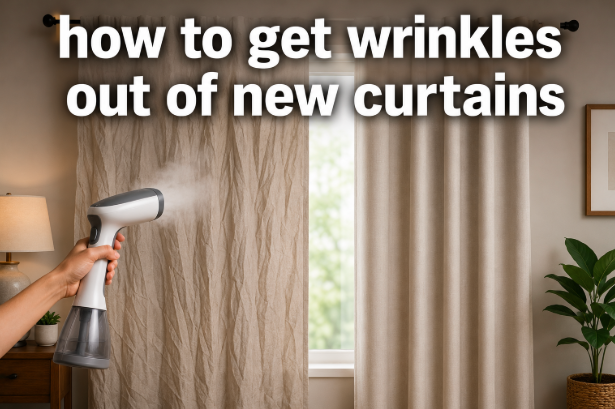
The fastest way to get wrinkles out of new curtains is to hang them on the rod first, then run a handheld steamer down the length of the fabric from top to bottom. The heat relaxes the fibers, and the weight of the hanging panel pulls each crease flat as the fabric cools.
No steamer on hand? A hot shower, a wrinkle release spray, or a short spin in the dryer with a damp towel will get you most of the way there.
Ironing works too, but it means taking the panel off the rod and carries the highest risk of scorching, so it’s worth trying a gentler method first, especially on a fabric you haven’t treated before.
Why do new curtains arrive so wrinkled?
New curtains arrive wrinkled because they spend days or weeks folded tightly inside plastic packaging and shipping boxes, and that pressure sets creases into the fibers the same way a fold sits in a stack of paper left under a heavy book.
Manufacturers fold panels into small, flat squares to cut shipping volume and cost, and ready-made curtains bought off a shelf are usually packed tighter and longer than custom or made-to-order panels, which is why they tend to arrive more creased.
The heading style plays a part too. Grommet and rod-pocket panels get folded flat with no give at the top, so the crease often runs straight across the header, while pinch-pleat curtains are usually pinned or boxed in their folded shape, which can leave the pleats looking flat until they’re hung and shaped by hand.
The longer the fabric sits compressed, and the heavier or stiffer the material, the deeper the fold line and the longer it takes to relax once the curtain is finally hung.
Check the fabric before you start
Look at the care tag sewn into the side seam before you steam, wash, or iron anything, because the fastest method is not always the safest one for that particular fabric.
Curtains sold in the United States fall under the same care label rules that cover most textile products, which require the manufacturer to list at least one safe way to clean and press the fabric.
As a quick rule, cotton, linen, and most polyester blends tolerate heat and steam well. Velvet, silk, sheers, and blackout linings do not, and treating the whole panel before testing a hidden corner, like the bottom hem or a side seam, is how a small mistake turns into an obvious one on the front of the curtain.
If the tag is missing or the print has worn off, treat the fabric as delicate and start with the gentlest method on this list before working up to more heat.
What heat and steam actually do to the fabric
Wrinkles form because heat, moisture, and pressure combine during folding to bend fibers into a new shape, and the fibers hold that shape once they cool and dry.
Steam and a hot iron work by reversing the same process: the added heat and moisture loosen the bonds between fibers just enough to let them move, and as the fabric cools back down in its new position, hanging flat instead of folded, the fibers set again in that smoother shape.
This is why gravity matters as much as the heat source itself. A curtain steamed while lying flat can re-wrinkle as soon as it’s picked up, while one steamed on the rod cools and sets in the exact position it needs to hang in.
The fastest fix: steam curtains while they hang
Steaming curtains on the rod is the quickest way to clear both packaging creases and fold lines, because gravity does half the work while the steam does the other half.
- Hang the panel exactly where it will live, wrinkles and all.
- Fill the steamer with distilled water rather than tap water, since minerals in tap water can build up in the nozzle and spit onto the fabric.
- Once heated, hold the head four to six inches from the curtain and work in slow, vertical strokes from the top down, smoothing the fabric with your free hand as you go.
- Give heavier or lined fabric a second pass over the most stubborn creases.
- Let the fabric air dry for ten to fifteen minutes before touching it again, then go back over any spot that still shows a line.
Most standard panels take ten to twenty minutes depending on thickness. If a helper is available, having one person hold the bottom of the panel taut while the other steams speeds things up considerably on wide or floor-length curtains.
No steamer? Try the bathroom steam trick
Hanging curtains in a steam-filled bathroom works almost as well as a handheld steamer, and it costs nothing. Run the hot water tap or shower for several minutes with the door and any windows closed, then hang the curtain panel on a rod, a towel bar, or even the shower curtain rail inside the room.
Leave it there for fifteen to twenty minutes while the steam works into the fibers, then move it straight to its usual spot and let gravity pull the last of the creases out as it dries.
Crack a window or turn on the fan afterward so the fabric and the room both dry out fully, which keeps a musty smell from settling into the curtain, especially on thicker or lined panels that hold moisture longer.
Wrinkle-release spray works fast and needs no heat
A wrinkle release spray is the quickest option when there’s no time for steam, and it works by relaxing the fibers with a light mist rather than heat. Spray the wrinkled area until it’s damp but not soaked, smooth the fabric flat with your hands, and let it air dry for about ten minutes.
This is especially useful for fabrics that can’t take direct heat, or for a quick touch-up on the fold lines near the top of the panel after another method has handled the rest.
Test the spray on a hidden section first, since it can leave a faint water spot on some silks and taffetas, and give it a few extra minutes on humid days when the fabric takes longer to dry.
Washing and drying works for machine-washable panels
If the care tag allows machine washing, a quick trip through the washer and dryer will usually remove even deep packaging creases. Wash the curtains on a cold, gentle cycle, and avoid overloading the machine so the fabric can move freely instead of bunching, which only adds new wrinkles.
To loosen wrinkles without a full wash, lightly mist the curtains with a spray bottle, add one damp towel to the dryer, and tumble on low heat or an air-fluff setting for ten to fifteen minutes. The damp towel creates steam inside the drum as it heats, which relaxes the fibers the same way a handheld steamer does.
Take the curtains out while they’re still slightly damp and hang them right away so the weight of the fabric finishes smoothing the last of the creases as it dries flat.
| Tip: Skip the dryer for dry-clean-only fabric or blackout panels with a rubber or foam backing, since dryer heat can crack that coating. Always remove curtains the moment the cycle ends rather than letting them sit balled up in a stopped dryer. |
Ironing curtains the safe way
Ironing removes even stubborn fold lines, but curtains are wide, so plan on taking the panel down and working on a large flat surface, like a bed or a folding table covered with a sheet, since most curtains don’t fit on a standard ironing board.
Set the iron according to the fabric: a low setting for silk or synthetic blends, medium for wool blends or heavier polyester, and the highest setting for cotton or linen. Rowenta’s iron temperature guide is a useful reference if the care tag doesn’t specify a setting.
Test the heat on a hidden scrap or seam allowance first, then work in small sections, moving the iron continuously rather than letting it rest in one spot. Place a thin cloth, like a pillowcase, between the iron and anything delicate or dark colored to avoid shine or scorch marks, and mist stubborn lines with water before pressing.
Cotton and linen press best while still slightly damp. Rehang the panel right away while it’s still warm so it settles into its hanging shape instead of a folded one.
Wrinkle removal by fabric type
Different curtain fabrics respond to heat and moisture in very different ways, so matching the method to the material prevents damage while still getting rid of the creases. Use this as a quick reference alongside the care tag.
| Fabric | Best method | Avoid |
| Cotton or poly blend | Steamer, or iron on low to medium heat | Overloading the dryer or washer |
| Linen | Steam or iron on high heat while still damp | Letting it dry fully before pressing; wrinkles return |
| Velvet | Hang and steam from a few inches away | Pressing an iron directly onto the nap |
| Silk or sheers | Hot shower steam, or a brief, gentle steamer pass from 6+ inches away | Direct ironing; tap water spots |
| Blackout or thermal-lined | Handheld steamer on the face fabric only, or a low-heat dryer cycle with a damp towel | Ironing or steaming the backing directly; high dryer heat |
Blackout and thermal-lined curtains deserve an extra note. The foam or vinyl coating on the back of the panel can melt, crack, or peel if it comes into direct contact with a hot iron or a steamer nozzle, so always work the face fabric only and keep the heat source a few inches away from the lining side.
How long it takes for creases to fall out on their own
Left alone, most fold lines relax within one to two weeks of normal hanging, and faster still in a warm, sunlit room, since heat and light soften the fibers in much the same way steam does.
Lightweight cotton, polyester blends, and sheers usually smooth out within a few days on their own. Heavier fabrics, like velvet or thick lined cotton, hold their creases longer and may still show faint lines after two weeks without some help from steam or moisture.
If there’s an event or a deadline coming up, it makes more sense to use one of the active methods above rather than wait it out.
Getting the folds to hang straight, not just wrinkle-free
Once the wrinkles are gone, curtains still need to settle into their intended pleats rather than the flat, boxy shape left behind by packaging.
Gently gather each panel by hand into the folds it’s meant to hang in, then tie it loosely at two or three points along its length with ribbon or soft twine. Leave it tied for twenty-four to forty-eight hours, or up to two weeks for stubborn, heavier polyester, then untie it.
This trains the fabric to fall in even, vertical folds instead of springing back into whatever shape it held in the box, and it works well as a finishing step right after steaming or washing while the fibers are still relaxed.
Keeping curtains from wrinkling again
A little care after the first wrinkle removal keeps the panels looking pressed for much longer. Fold curtains as little as possible between uses. If they need to come down for cleaning or storage, roll them loosely around a cardboard tube instead of folding them into squares, since rolling avoids the sharp lines that folding creates.
Store them in a breathable fabric bag rather than sealed plastic, which traps moisture and can encourage new creases or a musty smell. Give hanging curtains a light steam every few weeks as routine maintenance rather than waiting for deep creases to set in again, and choose curtain clips or rings that spread the fabric’s weight evenly across the rod, since bunching at a few points is a common source of new wrinkles near the top of the panel.
Conclusion
Getting wrinkles out of new curtains almost always comes down to matching heat and moisture to the fabric, then letting gravity finish the job. Hang the panels first, steam or spray the fold lines from top to bottom, and give the fabric time to relax before judging the result.
Cotton and linen can take a hot iron; silk, velvet, and blackout linings need a gentler touch. Within a day or two of the right treatment, or up to two weeks left hanging naturally, the panels should fall smooth and ready for the window.
Frequently asked questions
Do wrinkles in new curtains go away on their own?
Yes. Most fold lines relax within one to two weeks of normal hanging, especially in a warm room, though heavier fabrics like velvet or lined cotton can take longer than lightweight cotton or polyester blends.
Can I put brand new curtains in the dryer to get the wrinkles out?
Yes, if the care tag allows machine washing. Lightly mist the panel, add one damp towel to the dryer, and tumble on low heat for ten to fifteen minutes, then hang it while still slightly damp.
Is it safe to iron blackout curtains?
Only on the face fabric, using a low to medium setting and a press cloth. Never rest the iron directly on the backing, since the foam or vinyl coating can melt or crack under direct heat.
How do you get wrinkles out of curtains without ironing?
Hang the curtains and steam them with a handheld steamer, hang them in a steam-filled bathroom for fifteen to twenty minutes, or use a wrinkle release spray. All three relax the fibers without touching a hot iron to the fabric.
Why do my new curtains still have lines after steaming?
Deep fold lines from tight packaging sometimes need a second or third pass, a little more steam time held close to the stubborn spot, or a few extra days of hanging under the fabric’s own weight to fully release.
Related Articles
How to Stagger Pergo Flooring the Right Way?
What Is the Standard Depth of Kitchen Countertops?
Garage Floor Wet When It Rains: Causes & Fixes