


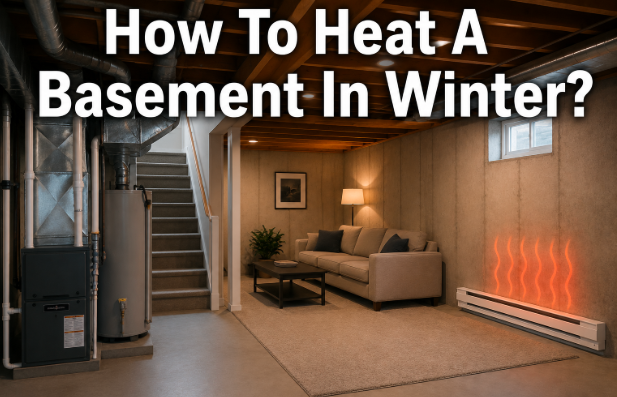
The fastest way to heat a basement in winter is to stop the heat loss first, then add a heat source sized for the room, such as a ductless mini-split heat pump, electric baseboard heater, or radiant floor system. Space heaters and extra HVAC vents can help too, but they work far better once the room actually holds onto heat.
Basements lose warmth fast because they sit below grade, surrounded by cold earth, and are often full of unsealed gaps, so equipment alone rarely solves a leaky room. Here is why basements run cold, which heating options actually work, and how to choose and use one safely.
Why does a basement get so cold in winter?
A basement sits partly or fully below ground, so the surrounding soil constantly pulls heat out of the concrete floor and walls. That same soil keeps a basement cooler in summer and milder in early winter than an above-ground room, but once outdoor temperatures drop and stay low, the ground itself cools and that advantage disappears.
Warm air rising through the rest of the house adds to the problem. As heated air moves up through the floors above, it pulls cold air down to replace it, a pattern known as the stack effect. That cold air settles in the basement, since it’s the lowest point in the house.
On top of that, most basements leak heat directly. Rim joists (the band where the foundation meets the wood framing), older basement windows, sill plates, and gaps around pipes and wiring all let cold air in and warm air out. Bare concrete floors and block walls also conduct heat away from the room quickly, since masonry holds almost no insulating value on its own.
Seal and insulate before you add heat
Sealing air leaks makes the biggest difference of anything you can do, and it costs the least. Cold air pools at the lowest point of a house, so even small gaps in a basement let in an outsized amount of it.
Check the rim joists, the sill plate where the foundation meets the framing, and the frames around basement windows. Caulk, weatherstripping, or spray foam close most of these gaps in an afternoon.
Once the leaks are sealed, insulation slows the heat that’s left from escaping. Rigid foam board or spray foam against bare concrete or block walls creates a thermal break between the cold masonry and the room.
If the walls are already framed with drywall, insulation can go in behind the studs instead. Rim joists deserve extra attention, since this narrow band is one of the largest single sources of heat loss in most basements, and foam board cut to fit between the floor joists closes it off.
A thick rug, carpet, or interlocking foam tiles over bare concrete flooring help as well. Concrete pulls heat away from feet and furniture directly, and a floor covering slows that transfer enough to make the room feel noticeably warmer, even before any heater turns on.
What is the best way to heat a basement?
The best option depends on whether the basement is finished or unfinished, how often you use it, and whether you want a permanent fix or a seasonal one.
A ductless mini-split heat pump mounts a small unit on a wall or ceiling and connects through a narrow hole to an outdoor compressor, so no ductwork is needed. It pulls heat from the outside air, even in cold weather, and moves that heat inside rather than generating it from scratch.
ENERGY STAR-certified mini-splits can use up to 60 percent less energy than standard electric baseboard heat, and cold-climate models are tested to keep working at outdoor temperatures as low as 5°F.
Electric baseboard heaters run along the wall near the floor and heat by convection: they warm the air right beside them, which then rises and circulates through the room. They need no ductwork or venting, just a dedicated circuit, so they’re simple to add to a finished or unfinished basement. They cost less to install than a mini-split but more to run day to day, since they turn electricity straight into heat instead of moving it from outside.
Radiant floor heating runs electric cable or hot water tubing under the floor, so the floor itself becomes the heat source and warmth rises evenly through the room. It suits a basement that’s being finished or remodeled, since it goes in before the finished flooring, and it removes the cold-concrete feel many basements have. Retrofitting it into an already finished basement is far more disruptive and expensive than installing it during construction.
If the basement is already framed for it, running a supply duct and return down from the main HVAC system brings the basement into the same heating zone as the rest of the house. This works best when the duct run is short and the basement is already well sealed, since long runs lose heat along the way and an unsealed basement will still feel colder than the floors above it.
A portable electric space heater is the fastest and cheapest way to add heat to a basement, since it needs no installation and starts heating the moment it’s plugged in. It suits occasional use, like a workshop or laundry area you’re only in for an hour at a time, better than round-the-clock heating, since running one continuously costs more than most other options and carries real fire risk.
A wood or pellet stove burns fuel to produce heat directly in the room. A pellet stove burns EPA-certified pellets and typically needs refueling only about once a day. Both need a vented flue to carry combustion byproducts, including carbon monoxide, outside the home, so proper venting and professional installation are not optional.
| Option | Best for | Install effort | Running cost |
| Ductless mini-split | Finished basements used year-round | Professional install, one wall penetration | Low, moves heat instead of generating it |
| Electric baseboard | Simple, permanent single-room heat | Dedicated circuit, no ductwork | Moderate to high |
| Radiant floor heat | New construction or full remodels | Installed under new flooring | Low once running, high upfront |
| Extended HVAC ductwork | Homes with existing central heat nearby | Ductwork extension | Moderate, tied to main system |
| Space heater | Occasional or spot heating | None, plug and go | High for continuous use |
| Wood or pellet stove | Off-grid or backup heat | Vented flue, professional install | Low fuel cost, daily refueling |
How to choose the right option for your basement
- Decide how you’ll use the space. A basement used daily as a living area needs steady, whole-room heat. One used a few hours a week for laundry or storage can usually get by with spot heating instead.
- Check what’s already down there. Existing ductwork, a nearby electrical panel, or a gas line all make certain options cheaper and faster to add than starting from nothing.
- Match the heat source to that use. Daily living space points toward a mini-split, baseboard heat, or radiant flooring. Occasional use points toward a space heater or a single ductless head.
- Size the equipment to the room, not just the square footage. Ceiling height, window area, and how well the space is sealed all affect how much heat it actually needs, so a contractor’s load calculation is worth getting before buying permanent equipment.
- Plan for venting from the start if you’re considering a gas, propane, or wood-burning option, since combustion appliances need a safe path for exhaust and outside combustion air.
- Bring in a licensed contractor for anything involving electrical circuits, gas lines, or ductwork. Permanent heating equipment also needs to meet local building and fire codes, which vary by area.
Space heater safety in a basement
Electric space heaters are the only kind safe to run indoors without outside venting, according to the Department of Energy, and a few basic habits prevent almost every basement heater fire. Basements often double as storage, which means boxes, furniture, and stacked belongings sit closer to a running heater than they would in a typical living room, so extra care matters here.
Keep any space heater at least three feet from anything that can burn, plug it directly into a wall outlet rather than an extension cord, and never leave it running when you leave the room or go to sleep.
Portable heaters, including electric space heaters, are involved in an average of about 1,600 home fires a year, resulting in roughly 70 deaths and 160 injuries annually. Most of these start when a heater sits too close to furniture, bedding, or boxes, which makes placement the single biggest safety factor in a basement.
Choose a model with a tip-over shutoff and an overheat sensor, and check that it carries a UL, ETL, or CSA safety listing before you buy it.
How much does it cost to heat a basement?
Running cost comes down to whether the equipment generates heat or moves it. Baseboard heaters and space heaters turn electricity directly into heat, so they’re simple and cheap to buy but more expensive to run for long stretches.
A ductless mini-split or an extended heat pump system moves existing heat from outside air instead of creating it, which uses less electricity per degree of warmth delivered, though the equipment and installation cost more upfront.
Radiant floor heating and ductwork extensions sit in between: both cost more to install than a space heater but are cheaper to run than pure resistance heat once they’re in place. Federal tax credits and local utility rebates are often available for qualifying heat pump installations, so it’s worth checking current programs before buying.
Conclusion
A warm basement starts with sealing and insulation, not equipment. Once air leaks are closed and the walls, rim joists, and floor are insulated, almost any heat source, from a ductless mini-split to a simple space heater, works better and costs less to run.
Match the option to how you actually use the space, size it properly, and have a professional handle anything involving gas, electrical circuits, or venting.
Frequently asked questions
Do I need to insulate my basement before adding a heater?
Yes. Sealing air leaks and adding insulation first means any heater you add works more efficiently and costs less to run, since the room actually holds the heat instead of losing it through gaps and bare concrete.
Is it safe to run a space heater in the basement overnight?
No. Space heaters should be turned off and unplugged whenever you leave the room or go to sleep, since running one unattended is one of the leading causes of home heating fires.
What’s the cheapest way to heat a basement?
Sealing air leaks and adding a thick rug or floor covering cost the least and make the biggest difference. For active heating, a space heater has the lowest upfront cost, though it’s not the cheapest to run continuously.
Can a mini-split heat an entire basement?
A single mini-split head can heat one open area effectively. A basement split into several rooms usually needs either multiple heads on one outdoor unit or a different option, like extended ductwork, for even coverage.
Do unfinished basements need heat in winter?
An unfinished basement doesn’t need to be as warm as living space, but keeping it above freezing protects pipes from bursting and helps control moisture and mold, both common problems in cold, damp basements.
Related Articles
How to Get Wrinkles Out of New Curtains (No Ironing Required)
How to Stagger Pergo Flooring the Right Way?
What Is the Standard Depth of Kitchen Countertops?