


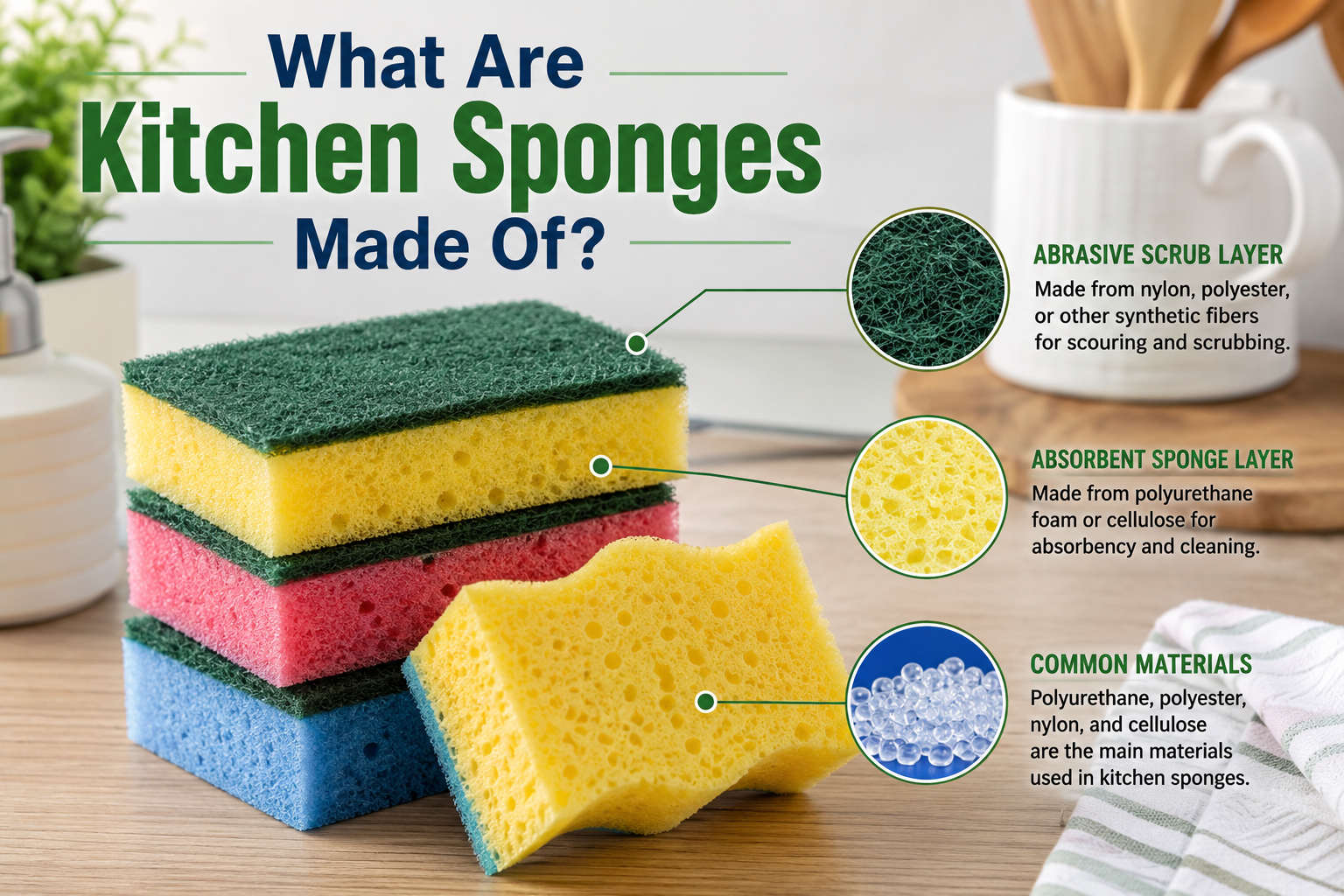
Most kitchen sponges are made of plastic. The soft, springy body is usually polyurethane foam, and the rough scrubbing side is usually polyester or nylon fibers held together with resin. Both come from petroleum. But that yellow-and-green sponge is only one option. Plenty of sponges are made from plant-based cellulose, and others come from natural fibers like loofah, coconut, or even the skeleton of a real sea animal. Here is what goes into each type, and how they are put together.
What are kitchen sponges made of?
Kitchen sponges are made from one of three broad material groups: synthetic plastics, plant-based cellulose, or natural animal and plant fibers. The version most people buy at the supermarket is fully synthetic. Its absorbent part is polyurethane, a foam plant-based on petroleum, and its scouring part is a mesh of stiff polyester or nylon.
Cellulose sponges are the main plant-based type. They start as wood pulp, the same raw material used to make paper, so they soak up water well and break down naturally at the end of their life. Then there are natural sponges, which are not manufactured at all in the usual sense. A natural sea sponge is the soft skeleton of a simple ocean animal, cleaned and trimmed for use. Loofah, another natural choice, is the dried inner network of a gourd.
Which one you have in your hand changes how it cleans, how long it lasts, and what happens to it after you throw it away. The rest of this guide walks through each material in turn.
The classic two-sided sponge, layer by layer
The familiar dish sponge has two working parts, and each is made of a different material for a different job.
The soft yellow side
The soft side is almost always polyurethane foam. Polyurethane is a synthetic polymer, a bit like a cross between rubber and plastic, and it was first developed in the 1930s. It is full of tiny open cells, which is what lets it soak up water and hold soapy suds. Manufacturers can dial in how soft or firm the foam is by changing the recipe, so the same base material can make a gentle sponge or a stiffer one.
The rough scrubbing side
The scratchy side, often green, is a separate layer. It is usually a web of polyester or nylon fibers coated and bonded with a tough resin, and sometimes fine abrasive grit is mixed in to boost its scouring power. This layer is designed to scrape off stuck-on food without falling apart. The two layers are then glued together with a moisture-curing adhesive to make the finished dual-sided sponge.
Good to know: both the yellow foam and the green scrub pad are plastics made from petroleum. That is why a standard dish sponge does not biodegrade and cannot be recycled in most places.
How synthetic sponges are made
Synthetic sponges start as liquid chemicals and end as foam blocks. The core of the process is polymerization, where small chemical building blocks link into long polymer chains. For the absorbent body, makers react the ingredients that form polyurethane while a gas is worked through the mixture, so it rises and sets like a cake full of bubbles. Those bubbles become the open cells that hold water.
The steps look roughly like this:
- Mix the raw chemicals so they react and begin to foam.
- Let the foam rise and cure into a large solid block.
- Make the scrubbing layer separately from bonded polyester or nylon fibers.
- Glue the foam and the scrub layer together with a moisture-curing adhesive.
- Cut the bonded block into individual sponges and package them.
Because the whole process is controlled by the recipe, manufacturers can make firm heavy-duty scourers or soft gentle sponges from closely related materials. That flexibility, along with low cost and durability, is why synthetic sponges took over the market.
Cellulose sponges: the plant-based option
Cellulose sponges are made from wood pulp, so their main ingredient is a plant, not petroleum. Along with the pulp, makers add hemp fibers for strength, sodium sulfate crystals, softeners, and dye. The result is soft, very absorbent, and fully biodegradable, which is why cellulose is a common pick for people who want to skip plastic.
The clever part is how the holes are formed. The cellulose is softened into a jelly-like paste, then mixed with the hemp, dye, and sodium sulfate crystals in a large rotating drum. That blend is poured into a mold and heated. As it cooks, the salt crystals melt and drain out through the bottom, and the empty spaces they leave behind become the pores of the sponge. The size of the crystals sets the size of the holes, so coarse crystals make a rougher sponge and fine crystals make a smooth one.
After cooking, the block is cleaned, bleached, and cut into individual sponges. Many are then treated with a mild soap so they stay soft and flat inside the packet, which is why a new cellulose sponge often needs a good rinse and a soak in water before its first use.
Natural sea sponges
A natural sea sponge is not manufactured at all. It is the soft skeleton of a real sea animal, one of the simplest creatures in the ocean, made of a flexible protein called spongin. Divers harvest these sponges, mostly in the eastern Mediterranean and off the coast of Florida. After harvesting, the living cells are cleaned away, and what is left is the soft, springy, honeycombed skeleton people have used for washing for thousands of years. You can read more about the animal itself on Britannica’s entry on the sponge.
Sea sponges are prized because they are soft, hold a lot of water, and last a long time when cared for. They cost far more than a plastic sponge, and because they are harvested from the wild, supply depends on healthy sponge beds. They are a niche choice today, but they are the original sponge that everything else imitates.
Plant-fiber alternatives: loofah, coconut, and more
If you want to clean without plastic, several natural fibers do the job. Each has its own texture and best use.
- Loofah: the dried inner skeleton of a gourd. It has an open, ropey structure that scrubs well and dries fast, and it is fully compostable.
- Coconut coir: the coarse fiber from a coconut husk. It is tough and abrasive, which makes it a strong plant-based replacement for a green scrub pad.
- Cotton and other plant fibers: soft, absorbent, and washable, so they work well for wiping and lighter cleaning.
- Walnut shell: sometimes ground and bonded onto a scrubbing layer to add grit from a natural source.
These options break down naturally and avoid shedding plastic into the water when you wash them. They can cost a little more and may wear differently than a synthetic sponge, but for many everyday tasks they clean just as well.
Quick comparison of sponge materials
Here is how the main sponge materials stack up at a glance:
| Material | What it is | Best for |
| Polyurethane foam | Petroleum-based plastic, soft and springy | Soaking up water and holding suds |
| Polyester or nylon | Stiff plastic fibers bonded with resin | The green scrubbing side |
| Cellulose | Made from wood pulp, plant-based | Absorbent, biodegradable everyday use |
| Loofah | The dried skeleton of a gourd | Natural scrubbing, compostable |
| Coconut coir | Coarse fiber from coconut husks | Tough scrubbing, plastic-free |
| Natural sea sponge | The skeleton of a real sea animal | Soft, gentle, long-lasting cleaning |
How to choose the right sponge
Start with what you clean most. For soaking up spills and washing dishes, a soft absorbent sponge wins, so polyurethane foam or cellulose both work. For scraping burnt pans, you want a firm scrubbing surface, which means a polyester scrub pad or a coconut coir scrubber.
Then think about waste. A standard plastic sponge is cheap and lasts, but it never breaks down and sheds tiny plastic particles every time you use it. If that matters to you, a cellulose sponge or a loofah gives you similar cleaning with a material that composts. Whatever you pick, let it dry fully between uses and swap it out regularly, because a damp sponge of any material becomes a home for bacteria fast.
Simple rule: match the sponge to the mess. Soft and absorbent for dishes and spills, firm and abrasive for scrubbing, and plant-based if you want it to break down when you are done.
Conclusion
Most kitchen sponges are plastic: polyurethane foam for the soft side and polyester or nylon for the scrubbing side, both made from petroleum. The main alternatives are cellulose from wood pulp, natural sea sponges made of spongin, and plant fibers like loofah and coconut coir. Pick a soft, absorbent material for dishes, a firm one for scrubbing, and a plant-based one if you want it to compost. Then dry it well and replace it often, and any sponge will serve you better.
Frequently asked questions
Are kitchen sponges made of plastic?
Most are. The common dish sponge is polyurethane foam on the soft side and polyester or nylon on the scrubbing side, and both are plastics made from petroleum. Cellulose and natural-fiber sponges are the main non-plastic options.
What is the yellow part of a sponge made of?
The soft yellow part is usually polyurethane foam. Its open, bubble-like cells are what let it soak up water and hold soapy suds while you clean.
Are cellulose sponges better for the environment?
Yes, in most ways. Cellulose comes from wood pulp, a renewable plant source, and it biodegrades at the end of its life. A standard plastic sponge does neither and sheds microplastics as it wears.
Is a natural sea sponge really an animal?
Yes. A sea sponge is one of the simplest ocean animals. The part you clean with is its soft skeleton, made of a protein called spongin, left behind after the living cells are cleaned away.
How often should I replace my kitchen sponge?
Every couple of weeks is a common guideline, sooner if it smells or looks worn. Sponges trap food and moisture, so bacteria build up quickly no matter what material they are made from.
Related Articles
How To Raise Water Level In Toilet Bowl? Complete DIY Fix Guide
Gap Between Wall and Ceiling: What Causes It and How to Fix It