


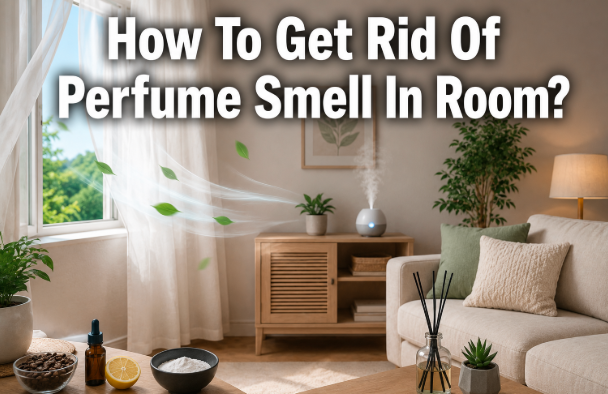
Open the room to cross ventilation, clean up whatever the perfume touched, then set out an odor absorber such as baking soda, activated charcoal, or fresh coffee grounds while the air clears. That combination handles almost every case, whether the smell came from a spill, an over-enthusiastic spray, or a fragrance a previous occupant left behind.
Perfume smell doesn’t sit only in the air. It settles into carpet, curtains, bedding, and anything porous in the room, which is why opening a window by itself often isn’t enough. A fast fix works on three fronts at once: it clears the air, cleans whatever the perfume touched directly, and pulls the scent out of fabric. Skip one of those fronts and the smell tends to creep back within a day or two, even after the room seems fine.
Here is each step in order, what actually absorbs a strong scent, when an air purifier is worth buying, and how to stop the problem from coming back.
Why does perfume smell stick around in a room?
Perfume clings because it’s built from compounds designed to evaporate slowly, and because those compounds settle into anything porous in the room. Fragrance oils are mostly volatile organic compounds, or VOCs, chemicals that release as gas at normal room temperature. Concentrations of VOCs indoors run consistently higher than outdoors, sometimes by a wide margin, and fragranced products are one of the main sources.
A bottle of Eau de Parfum has more fragrance oil and less alcohol than a lighter Eau de Toilette, so it holds its scent longer on skin and in a room. Perfume is also built in layers. The top notes fade within minutes, the middle notes last a few hours, and the base notes, usually musk, amber, or woody resins, are chosen specifically because they evaporate slowly and anchor the whole scent. Those base notes are why a room can still smell strongly of perfume a full day after the bottle was capped.
Once airborne, perfume molecules land on soft surfaces and stay there. Carpet fibers, curtains, upholstery, and bedding all have huge surface areas at a microscopic level, which gives fragrance molecules plenty of places to hide. Hard surfaces like glass, tile, or sealed wood hold less of it, but a fresh spill on any surface will keep releasing scent into the air for as long as it sits.
A concentrated perfume smell isn’t just unpleasant for some people either. Strong fragrance in a closed room can bring on a headache or a scratchy throat for anyone sensitive to it, and it can trigger real symptoms in people with asthma or migraines. That’s one more reason to work on all three fronts, air, source, and fabric, rather than waiting for the smell to fade on its own.
Step 1: Open the room to cross ventilation
Open two points on opposite sides of the room, a window and a door, or two windows, so air actually flows through the space instead of just sitting near one opening. A single open window barely moves air; cross ventilation pulls the scented air out and pulls fresh air in behind it.
A box fan speeds this up a lot. Set it in the window facing outward so it pushes room air outside rather than pulling outside air in, and leave it running for 15 to 20 minutes at a time. In cold weather, run this in short bursts rather than leaving windows open all day. Even ten minutes of real cross ventilation, done two or three times, clears more scent than an all-day single window.
If the room has a ceiling fan or an exhaust fan, run it too. Moving air is doing most of the work here, more than any product you set out afterward.
Step 2: Find and deal with the source
If perfume spilled or soaked into a specific item, deal with that item before anything else, because a fresh source keeps releasing scent faster than ventilation or absorbers can clear it. A capped bottle sitting on a dresser is not a source. A puddle on the carpet, a soaked cushion, or an oversprayed curtain is.
For a spill on a hard surface, blot up the liquid with a paper towel first; don’t rub, since rubbing spreads it into a wider area. Then wipe the spot with a damp cloth and a little dish soap or an all-purpose cleaner. For a spill on carpet or fabric, blot out as much liquid as you can, then treat it the way you would a stain: a mix of water and a small amount of mild detergent, worked in gently and blotted again, followed by a full wash or a professional clean if the item allows it.
If an item is small enough to remove from the room entirely, a throw pillow or a piece of clothing, take it out while you work on everything else. It’s much easier to treat one item on its own than to try to out-absorb it while it keeps releasing scent into the air.
Step 3: Pull the smell out of the air
Bowls of baking soda, activated charcoal, or fresh coffee grounds set around the room absorb a lot of what’s still floating in the air over the next 24 to 48 hours. These work through different mechanisms, so it’s worth picking the right one for how strong and how fresh the smell is.
Baking soda, or sodium bicarbonate, is a mild base. It reacts chemically with acidic odor compounds and converts them into compounds that no longer evaporate, which is why it neutralizes smell instead of just masking it.
Spread it across a plate or shallow bowl for more surface area, since a narrow opening in a box does very little. Activated charcoal works differently: it’s extremely porous, so odor molecules physically stick to its surface as air passes over it, a process called adsorption. Coffee grounds work in a similar physical way and add a mild scent of their own while they work.
| Absorber | How it works | Best for | Time needed |
| Baking soda | Neutralizes acidic odor molecules chemically | General, mild to moderate smell | 24 to 48 hours |
| Activated charcoal | Traps odor molecules on a porous surface | Strong or stubborn smell | 24 to 72 hours, reusable for weeks |
| Fresh coffee grounds | Physically absorbs odor, adds mild scent | Quick, low-cost option | 12 to 24 hours |
| White vinegar (in a bowl) | Acetic acid reacts with odor compounds | Strong smell, well-ventilated room | 24 to 48 hours |
A quick way to speed any of these up: place two or three bowls around the room instead of one, especially near where the smell is strongest, rather than one large bowl in a corner.
White vinegar works too, left uncovered in a bowl, though the room will smell faintly of vinegar for a few hours before that fades along with the perfume. Skip the temptation to spray a heavy air freshener over the top of any of this. A strong new scent layered over perfume usually just creates a third, worse smell, rather than removing either one.
Step 4: Wash and wipe down everything that trapped the scent
Perfume clings to fabric more than it clings to open air, so washing and wiping down whatever it touched usually removes more lingering smell than air treatments alone. Curtains, bedding, throw pillows, and couch covers should go through a normal wash with regular detergent; adding a cup of white vinegar to the rinse cycle helps break down what detergent alone leaves behind.
For carpet, rugs, and upholstered furniture that can’t go in a washing machine, sprinkle baking soda generously over the surface, let it sit for several hours or overnight, then vacuum it up completely.
A steam cleaner works even better if one is available, since the heat helps release scent trapped deep in the fibers rather than just sitting on top of them. Wipe down hard surfaces, shelves, nightstands, doorknobs, anything perfume mist may have settled on, with a cloth and a mild detergent solution.
If a spill soaked deeply into something like a mattress or a heavily padded item, expect this step to take more than one round. Clean it, let it dry fully, and repeat if the smell is still noticeable once it’s dry, since a lingering scent under a damp surface is often just trapped moisture holding it in place.
Should you use an air purifier?
An air purifier helps, but only if it includes an activated carbon filter, because a standard HEPA filter traps physical particles like dust and pollen and does not remove the gas molecules that make up perfume’s smell. This trips up a lot of people, since HEPA is the feature most air purifiers advertise loudest.
HEPA filters catch particles as small as 0.3 microns, but perfume’s scent comes from VOCs, gas-phase molecules that are far smaller and simply pass through a HEPA filter’s fibers untouched. Removing that kind of odor requires adsorption, the same principle behind activated charcoal in a bowl, just built into a filter the air passes through repeatedly.
The EPA’s overview of volatile organic compounds describes them as organic chemical compounds that evaporate under normal indoor temperature and pressure, which is exactly the property that lets perfume spread through a room in the first place.
If you’re shopping for a purifier specifically for this problem, look for one that lists a carbon or charcoal filter stage, not just HEPA, and check that the carbon filter has real bulk to it rather than a thin coating over a HEPA layer, since a token amount of carbon saturates fast and stops helping within days.
Match the unit to the room size too; a purifier rated for a much larger space than the one it’s in will clear the air faster. For a one-time perfume incident, though, a purifier is optional. Ventilation, cleaning the source, and bowls of absorbers handle most cases without buying anything.
How long does it actually take?
A light over-spray usually clears within 4 to 6 hours of good ventilation and a bowl or two of baking soda. A spill that soaked into carpet, fabric, or a cushion typically takes 24 to 72 hours, even with absorbers actively working, since the scent has to release from deep in the material rather than just the surface.
Heavily saturated items, a fully soaked rug pad or mattress topper, for example, sometimes never fully clear and are worth replacing rather than chasing the smell for weeks.
Humidity slows all of this down. A muggy room holds onto scent molecules longer than a dry one, so running a dehumidifier or air conditioner alongside ventilation speeds up the timeline noticeably.
How to stop it from happening again
Spray perfume into the air and walk through the mist, or apply it directly to skin, rather than spraying it onto curtains, bedding, or upholstery, since fabric holds fragrance far longer than skin does and is much harder to wash on short notice. Apply it near an open window or in a room with some airflow rather than in a small, closed space.
Store bottles capped and away from direct heat or sunlight. Heat speeds up evaporation, which means a bottle left on a sunny windowsill releases more scent into the room over time even while it’s just sitting there, and it also degrades the fragrance itself.
Keep bottles on a tray or in a closed drawer rather than balanced on the edge of a shelf, since a knocked-over bottle is the single most common way a whole room ends up smelling like this in the first place.
If a spill happens, clean it within minutes rather than letting it sit. The longer perfume sits on a surface, the deeper it soaks in, and the longer every step above will take.
Conclusion
A room that smells overwhelmingly of perfume clears fastest with cross ventilation, a cleaned-up source, and an odor absorber like baking soda or activated charcoal working in the background for a day or two.
Wash whatever fabric caught the scent, since that usually holds more of it than the air does. Done together, most rooms smell neutral again within a day, and a good result is air and fabric that smell like nothing at all, not like a second fragrance layered on top.
Frequently asked questions
Does Febreze or a fabric spray actually get rid of perfume smell?
Fabric sprays can help mask mild lingering scent on soft surfaces, but they don’t remove perfume that’s soaked deep into fibers. For a strong smell, wash the fabric or use baking soda and a vacuum instead.
Will the perfume smell go away on its own if I just wait?
A light scent fades on its own within a day or two as VOCs evaporate. A spill or heavy over-spray usually needs ventilation, cleaning, and an absorber to clear at a reasonable pace.
Can vinegar make a room smell like vinegar instead of perfume?
Briefly, yes. An open bowl of vinegar smells noticeable for a few hours, but that smell fades quickly on its own and takes a good amount of the perfume scent with it.
Does opening a window in winter still help?
Yes, in short bursts. Ten to fifteen minutes of real cross ventilation two or three times a day clears more scent than leaving one window cracked all day, and it won’t cool the room as much.
What removes perfume smell from a mattress?
Sprinkle baking soda generously over the surface, let it sit for several hours or overnight, then vacuum thoroughly. Repeat once if needed, and use a mattress protector afterward to make future spills easier to handle.
Related Articles
What Is the Average Height of a Door?
How to Clean Yellow Drips on Bathroom Walls?
How to Overlap Metal Roofing Lengthwise for a Leak-Free Roof?
How to Get Super Glue Off a Wood Floor? Without Ruining the Finish