


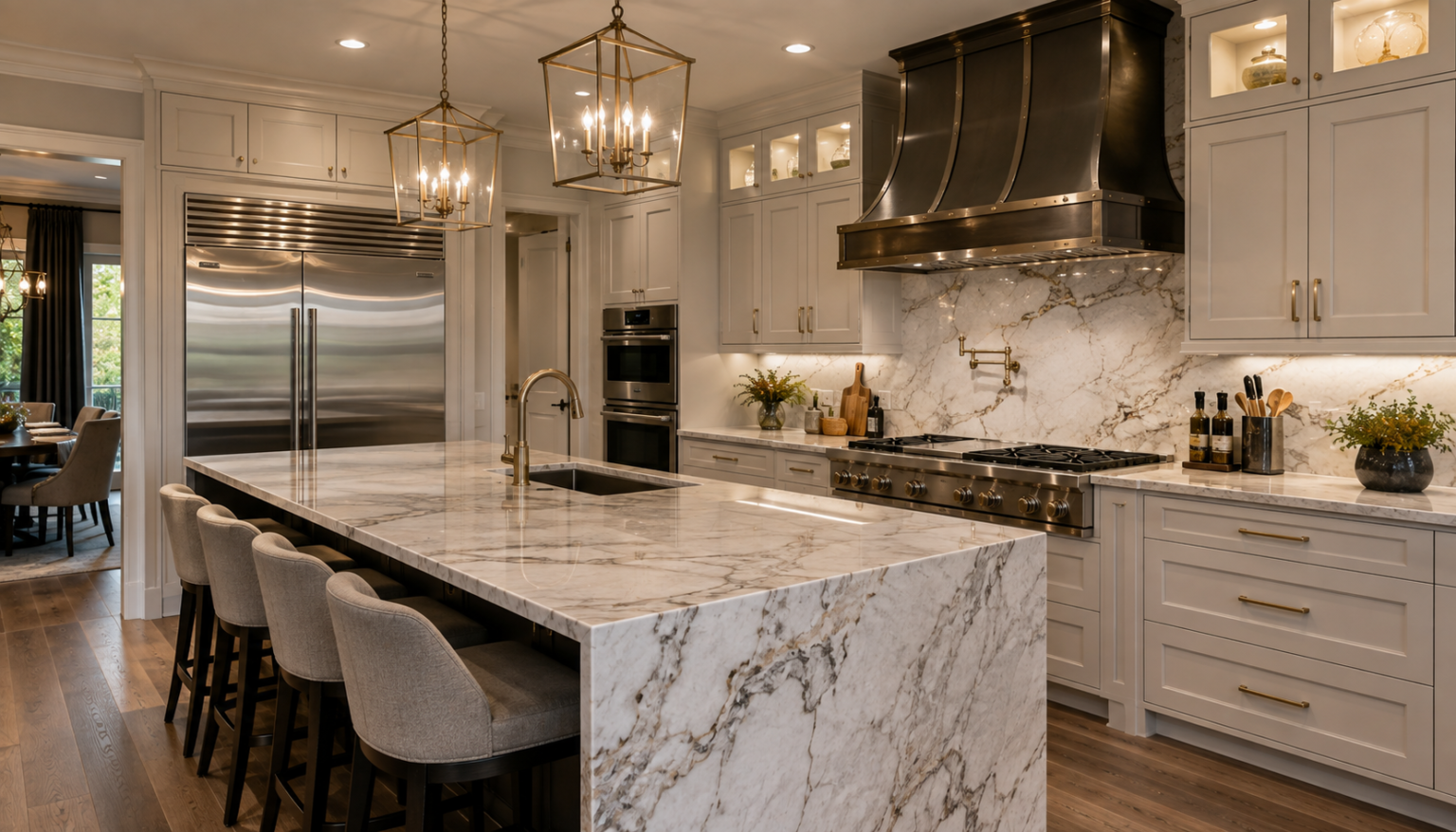
If you’re planning a renovation, the most expensive part of a kitchen remodel is almost always cabinetry, typically eating up 30% to 40% of your total budget. But that single fact only tells part of the story. Depending on your kitchen’s size, your layout choices, and how much structural work is involved, labor and appliances can climb close behind — and in some projects, even overtake cabinets.
This guide breaks down exactly where your money goes, why cabinets cost so much, and how to protect your budget from the surprises that catch most homeowners off guard.
Quick Answer: Where Your Kitchen Remodel Budget Goes
Before digging into the details, here’s the short version. Across most full kitchen remodels in the United States, spending tends to break down like this:
| Budget Category | Typical Share of Total Cost |
|---|---|
| Cabinetry | 30% – 40% |
| Labor & Installation | 15% – 20% |
| Appliances & Ventilation | 12% – 15% |
| Countertops | 8% – 12% |
| Flooring | 5% – 8% |
| Lighting, Backsplash, Plumbing Fixtures, Paint | 8% – 12% |
These percentages shift depending on whether you’re doing a cosmetic refresh or a full gut renovation, but the order rarely changes. Cabinets lead the list in almost every kitchen remodel, regardless of region or home size.
Why Cabinets Are the Most Expensive Part of a Kitchen Remodel
Cabinets cost the most because they combine three cost drivers that no other kitchen component has all at once: they cover the most square footage in the room, they require the most raw material, and they demand the most skilled labor to build and install correctly.
A full run of kitchen cabinetry isn’t one product — it’s dozens of individual boxes, doors, drawers, and hardware pieces, each requiring precise measurements, quality wood or engineered material, a durable finish, and careful installation. Add in features homeowners now expect as standard, like soft-close hinges, full-extension drawer glides, and pull-out organizers, and the cost compounds quickly across a full kitchen.
Stock vs. Semi-Custom vs. Custom Cabinets
The single biggest factor in your cabinet budget is which tier you choose. Here’s how they compare:
| Cabinet Tier | Typical Cost | What You’re Paying For |
|---|---|---|
| Stock | $100 – $300 per linear foot | Pre-built, standard sizes, limited style and finish options |
| Semi-Custom | $150 – $650 per linear foot | Standard construction with more size, finish, and storage flexibility |
| Custom | $500 – $1,200+ per linear foot | Built to your exact specifications and materials, maximum design freedom |
For a typical 10-foot by 10-foot kitchen layout (roughly 30–40 linear feet of cabinetry), that means stock cabinets might run $4,000 to $9,000, while a full custom package can easily exceed $20,000 to $30,000. This is why cabinet decisions deserve more planning time than almost any other part of your remodel.
What Determines Your Total Kitchen Remodel Cost
Cabinets may be the biggest single line item, but your overall budget depends heavily on the scope of the project and the size of your kitchen. National industry benchmarks from Remodeling Magazine’s Cost vs. Value report break kitchen projects into three general tiers:
- Minor remodel (cosmetic refresh): New cabinet fronts, hardware, countertops, and fixtures without moving anything structural. Typically $25,000 to $45,000.
- Major midrange remodel: Full cabinet replacement, new countertops, appliances, flooring, and lighting, generally within the existing footprint. Typically $60,000 to $90,000.
- Major upscale remodel: High-end materials, custom cabinetry, premium appliances, and often some layout changes. Typically $100,000 to $200,000+.
Kitchen size matters just as much as scope. A small kitchen under 100 square feet might complete a full remodel for $25,000 to $40,000, an average kitchen between 150 and 250 square feet often lands between $45,000 and $75,000, and a large kitchen over 300 square feet, especially with an island, can easily run $80,000 to $150,000 or more.
The Full Cost Breakdown, Category by Category
Labor and Installation
Labor typically accounts for 15% to 20% of a kitchen remodel budget on its own, but its real impact is bigger than that number suggests. Labor is what every other decision runs through. Moving a sink, relocating a range, taking down a wall, or rerouting plumbing and electrical lines doesn’t just add its own cost.
It multiplies the labor required across multiple trades, adds permitting time, and increases inspection risk. This is why two kitchens with identical finishes can end up thousands of dollars apart in total cost, simply because one kept the existing layout and the other didn’t.
Appliances
Appliances typically make up 12% to 15% of the budget, though this is the category with the widest range. A basic appliance package with a standard refrigerator, range, dishwasher, and microwave can run $3,000 to $8,000. Move into professional-grade or fully built-in appliances, and that number can climb past $20,000 to $30,000 on its own. Beyond the sticker price, changing a gas, plumbing, or electrical hookup to fit a new appliance adds labor cost that’s easy to underestimate during planning.
Countertops
Countertops generally run 8% to 12% of the total budget. Material choice drives most of the variation: laminate starts around $20 to $50 per square foot installed, quartz and granite typically run $50 to $150 per square foot, and premium natural stone or specialty surfaces can exceed $200 per square foot. Fabrication details matter too. Waterfall edges, oversized islands, and custom cutouts for sinks and cooktops can add several hundred to a few thousand dollars beyond the base material cost.
Flooring
Flooring usually accounts for 5% to 8% of the budget. Vinyl and laminate sit at the affordable end, typically $3 to $10 per square foot installed, while tile and hardwood run higher depending on species, pattern, and installation complexity. One frequent surprise: if demolition reveals subfloor damage, that repair becomes an unplanned cost that isn’t in most initial estimates.
Lighting, Backsplash, Plumbing Fixtures, and Paint
These smaller categories collectively make up 8% to 12% of the budget. None of them is individually expensive, but together they add up fast, especially if selections are made piecemeal near the end of a project rather than planned as part of the overall design.
Why Kitchen Remodels Go Over Budget (And How to Prevent It)
Even homeowners who plan carefully often end up spending more than expected. Understanding why helps you avoid the same traps.
Allowances that aren’t real prices. Many contracts include placeholder “allowances” for items like countertops or tile that haven’t been selected yet. If your actual choice costs more than the allowance, you cover the difference through a change order, often mid-project when switching course is expensive and inconvenient.
Hidden conditions behind the walls. Older homes especially can reveal outdated wiring, plumbing that doesn’t meet current code, or structural issues once demolition begins. These aren’t optional fixes; they’re often required for safety and permitting.
Scope creep. It’s common to add a small upgrade here and there once construction is underway, a slightly better faucet, an extra pendant light, a nicer cabinet pull. Individually minor, these additions compound over a full project.
Practical ways to protect your budget:
- Build a contingency fund of 10% to 20% of your total project cost before you start, specifically for the unknowns behind your walls.
- Finalize every material and finish selection before signing a contract, rather than leaving choices for “later.”
- Ask your contractor directly whether your quote includes fixed prices or allowances, and get any allowance amounts in writing.
- Keep your existing layout where possible. Reconfiguring inside the current footprint is consistently one of the biggest cost-savers available.
Where to Spend and Where to Save
You don’t need a top-tier budget in every category to get a kitchen that looks and functions like one. A few guiding principles apply to almost any budget level:
- Spend on cabinetry in your primary work zone. The cabinets you open daily, near the sink, stove, and main prep area, are worth the investment in quality hardware and construction.
- Save on cabinetry in low-traffic zones. Decorative upper cabinets on a rarely used wall don’t need the same tier as your working cabinets.
- Consider refacing over replacing. If your existing cabinet boxes are structurally sound, refacing doors and drawer fronts can deliver much of the visual upgrade of new cabinets for a fraction of the cost.
- Choose semi-custom over full custom when budget is tight. Semi-custom cabinetry preserves most of the design flexibility of custom work at a meaningfully lower price point.
- Simplify countertop fabrication. Standard edges and fewer specialty cutouts cost less and are barely noticeable in the finished kitchen.
- Keep your existing layout. This is consistently the single biggest lever for controlling both labor and overall project cost.
Is It Worth Spending More on the Most Expensive Part of a Kitchen Remodel?
For most homeowners, yes, within reason. Cabinets and countertops are the two upgrades that appraisers and buyers notice first, and they’re also the components that take the most daily wear. According to Remodeling Magazine’s Cost vs. Value report, a minor kitchen remodel typically recoups a higher percentage of its cost at resale than a major upscale one, largely because moderate cabinet and countertop upgrades appeal to a broader range of buyers without pricing the kitchen far above the rest of the home. If you’re remodeling primarily to sell, a well-executed midrange cabinet and countertop upgrade is usually a smarter investment than a fully custom, top-of-market kitchen.
If you’re remodeling to stay in your home for years, it makes sense to weigh durability and daily function more heavily than resale value alone. Either way, cabinetry is the category most worth getting right the first time, since replacing it again down the line is disruptive and costly.
Financing the Most Expensive Part of Your Remodel
Because cabinetry represents such a large share of the budget, many homeowners look at financing options to spread out the cost rather than paying entirely out of pocket.
Common paths include a home equity loan or home equity line of credit (HELOC), which typically offer lower interest rates since they’re secured by your home; a cash-out refinance, which can make sense if current mortgage rates are favorable; and personal loans or contractor-offered financing plans, which are faster to secure but usually carry higher interest rates.
Whichever route you choose, it’s worth getting a firm, detailed quote for your cabinetry and full project cost before applying, so you’re financing an accurate number rather than a rough estimate.
Frequently Asked Questions
What is the most expensive part of a kitchen remodel? Cabinetry is the most expensive part of a kitchen remodel for the vast majority of homeowners, typically accounting for 30% to 40% of the total budget. Labor and appliances are usually the next-largest expenses.
What are the three most expensive items in a kitchen remodel? The three biggest expenses are typically cabinetry, labor and installation, and appliances, in that order. Countertops often rank fourth, followed by flooring and smaller finish work.
Is it cheaper to reface or replace kitchen cabinets? Refacing is almost always cheaper than full replacement, often costing 30% to 50% less, since it reuses your existing cabinet boxes and only replaces doors, drawer fronts, and hardware. Refacing only works well if the boxes are structurally sound and you’re happy with your current layout.
How much should I budget for a kitchen remodel? Budgets vary widely by kitchen size and scope, but most full kitchen remodels in the U.S. fall between $25,000 for a minor cosmetic refresh and $150,000 or more for a large, high-end renovation. A realistic starting point for a midrange, average-size kitchen is $45,000 to $75,000.
What makes a kitchen remodel go over budget? The most common causes are contract allowances that don’t reflect real prices, unexpected issues discovered behind walls or under flooring once demolition starts, and scope creep from small upgrades added mid-project. Building a 10% to 20% contingency into your budget upfront is the most effective way to prepare for this.
Do custom cabinets add resale value? Custom cabinets can add value, but they don’t always return their full cost at resale. Moderate, quality upgrades in cabinetry and countertops tend to appeal to more buyers and recoup a higher percentage of their cost than fully custom, top-of-market finishes.
Final Thoughts
Cabinetry is the most expensive part of a kitchen remodel for most homeowners, but it’s rarely the only cost that matters. Labor, appliances, and countertops all have the potential to reshape your final number, especially once layout changes, hidden repairs, or contract allowances enter the picture. The homeowners who stay closest to their original budget are the ones who plan every selection before signing a contract, build in a real contingency fund, and know exactly which line items are fixed prices versus placeholders.
Before you start your own kitchen remodel, get itemized quotes for cabinetry, labor, and appliances specifically, since these three categories will shape the bulk of your budget. If you’re ready to move forward, request a detailed, written estimate from a qualified local contractor so you can compare real numbers instead of national averages, and start your remodel with a budget you can actually count on.
Related Articles
How Much To Paint A Ceiling? Complete Cost Guide
Why Do Basement Windows Leak? Causes, Fixes & Prevention Guide
Should Curtains Touch the Floor? The Complete Guide to Curtain Length