


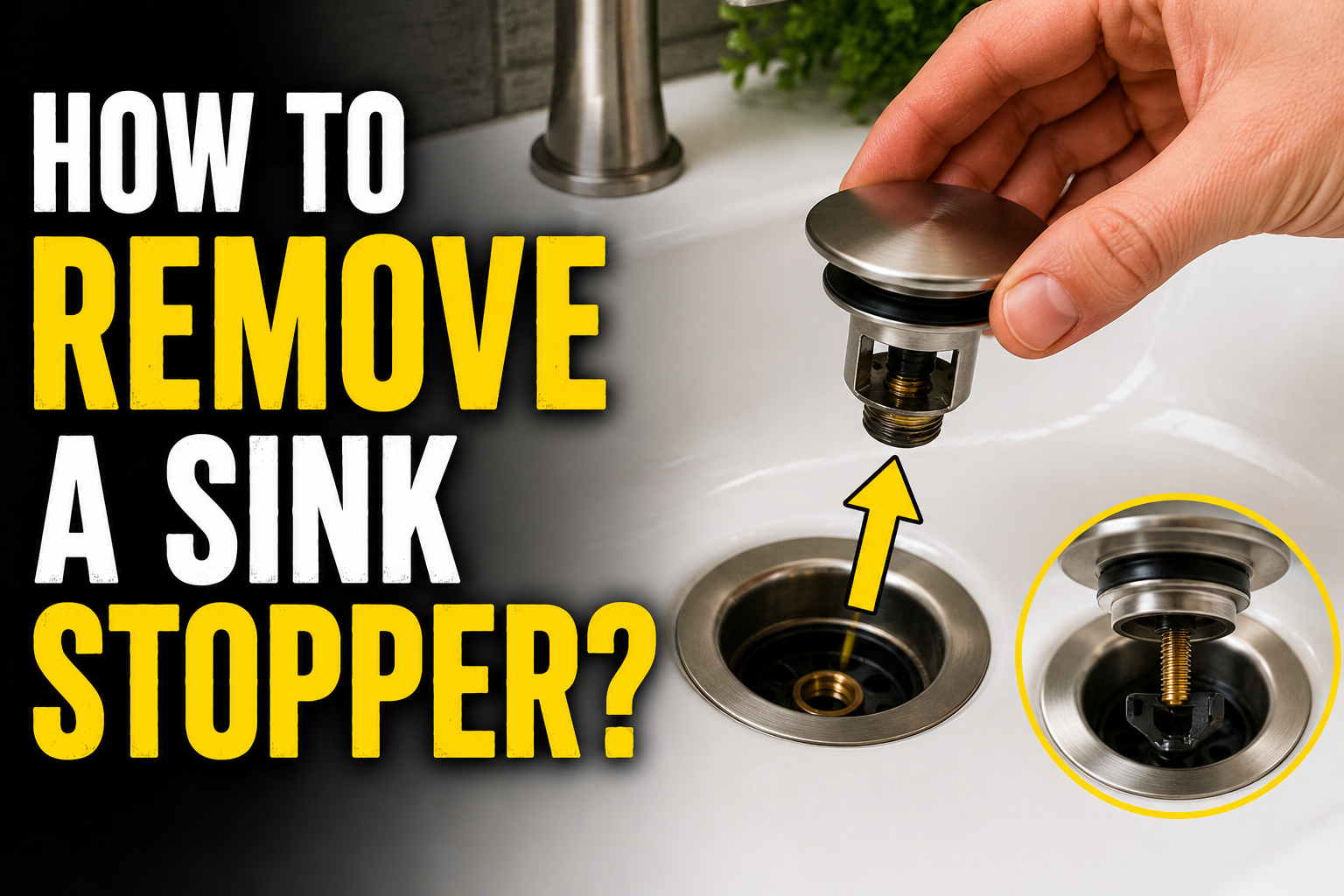
To remove a sink stopper, first try lifting it straight up and giving it a twist. Many stoppers come out by hand. If yours won’t budge, it’s held by a rod under the sink, and you’ll need to unscrew one nut to free it. Which method you use depends on the type of stopper you have, so the trick is to match the steps to your stopper.
This guide walks through every common type. Find yours below and follow that section. Most of these jobs take under 15 minutes and need no special tools.
First, figure out which stopper you have
The removal method changes with the type, so start by looking at what’s in your drain. There are four common kinds:
- Pop-up: A metal stopper that rises and drops when you pull a small lever behind the faucet. This is the standard in most bathroom sinks.
- Lift-and-turn: Has a small knob on top. You lift and twist it to open or close the drain.
- Push-and-pull: Looks almost identical to a pop-up, but you push it down and pull it up by hand instead of using a lever.
- Basket strainer: The metal basket found in most kitchen sinks. It catches food scraps and often has a rubber stopper that drops in.
Not sure? Try the easy test first. Grab the stopper, lift it, and turn it counterclockwise. Lift-and-turn and push-and-pull types often pop right out this way. If it lifts a little but then catches, it’s almost certainly a pop-up held by a rod, and you’ll be working under the sink.
One more quick check: look behind the faucet. If there’s a small lever or knob that sticks up and moves the stopper when you pull it, that confirms a pop-up. No lever means you have one of the hand-operated types, which are simpler to remove.
What you’ll need
Most removals need little or nothing. Keep these within reach:
- A flashlight or headlamp, since the space under a sink is dark and tight.
- A pair of pliers or channel-lock pliers for a stubborn nut.
- A small bucket or old towel to catch drips.
- Rubber gloves, because whatever you pull out will not be pretty.
How to remove a pop-up sink stopper
A pop-up stopper is held in the drain by a horizontal metal rod that runs into the back of the drain pipe under the sink. This rod, called the pivot rod, is what moves the stopper up and down when you work the lever. To take the stopper out, you disconnect that rod. Here’s the step-by-step:
- Clear out the cabinet under the sink and point your flashlight at the drain pipe. Give yourself room to reach.
- Find the pivot rod. It’s the thin horizontal rod sticking out of the back of the drain pipe, roughly halfway up. It connects to a flat metal strip with holes in it, called the clevis strap.
- Note which hole the rod is threaded through and how the parts sit together. A quick phone photo here saves you guesswork when you put it back.
- Unscrew the pivot nut. This is the nut where the pivot rod enters the drain pipe. Turn it counterclockwise by hand, or use pliers if it’s tight. Have your towel or bucket ready, since a little water may drip out.
- Pull the pivot rod straight back, out of the drain pipe, about an inch. This releases the bottom of the stopper.
- Go back up top and lift the stopper straight out of the drain. It should come free easily now.
If the rod feels stuck to the strap, you can also just unhook the clevis strap and slide the whole rod assembly aside instead of fully removing the nut. For a manufacturer’s take on the same pivot-rod method, Delta Faucet has a short guide to removing a bathroom sink stopper that mirrors these steps.
How to remove a lift-and-turn stopper
A lift-and-turn stopper is the easiest to remove because it usually unscrews by hand. You’ll know you have one by the small knob on top. Here’s how:
- Turn the stopper so it drops into the closed position.
- Lift it up slightly, just above the drain, and hold it there.
- Twist it counterclockwise. Most of these unscrew off a small post underneath.
- Once it stops turning, lift it straight out.
Some models have a tiny set screw on the knob or the base. If the stopper spins but won’t lift free, look for that screw, loosen it with a screwdriver or a small hex key, and try again. Hold the base steady with one hand while you turn the knob so the whole thing doesn’t just rotate in place.
How to remove a push-and-pull stopper
A push-and-pull stopper looks like a pop-up but works by hand, with no lever. Removal is close to the lift-and-turn method:
- Pull the stopper up to the open position.
- Hold the base of the stopper steady. There’s usually a knurled cap or nut you can grip.
- Unscrew the cap or knob by turning it counterclockwise while holding the base still.
- Lift the stopper out once the top piece is off.
If it feels seized, wrap the cap in a cloth for grip and try again gently. These caps are often plastic, so don’t force them with metal pliers or you may crack the part.
How to remove a kitchen sink basket strainer stopper
Kitchen sinks are different. Many use a basket strainer, and the removable part is often just a rubber or silicone stopper that drops into the basket. If that’s what you have, lift it straight out with your fingers. Done.
Some kitchen strainers use a spin-lock or twist-and-drop stopper instead. For a spin-lock, twist the top counterclockwise until it unthreads, then lift it out. For a twist-and-drop, turn it a quarter turn and pull up.
Removing the whole basket assembly is a bigger job, because it’s held to the sink by a large locknut underneath and sealed with plumber’s putty. You only need to do that if the strainer itself leaks or needs replacing. If you’re heading down that path, Family Handyman has a clear walkthrough for replacing a kitchen basket strainer that covers the locknut and putty steps.
What to do if the stopper is stuck
Buildup is usually the reason a stopper won’t move. Years of soap, hair, and grime cement it in place. A few things help:
- Twist while you lift. Rotating the stopper as you pull breaks the grip of the gunk around it.
- Pour hot water down the drain first. Heat softens grease and soap scum, which can loosen a stopper that feels welded in.
- Spray the pivot nut with penetrating oil if it’s corroded. Let it sit 10 to 15 minutes, then try the nut again with pliers.
- Check for a hidden set screw. On lift-and-turn types, a stopper that spins forever but won’t come out almost always has a small screw holding it on.
If a metal nut under the sink is rusted solid and won’t turn even with penetrating oil, stop and think before you force it. Overtightening or cranking too hard can crack the drain pipe or the sink. At that point, a plumber is cheaper than a new sink.
It also helps to hold the drain pipe steady with your other hand while you work a stubborn nut. The pipe under the sink is only hand-tightened at its joints, and twisting hard on the pivot nut can loosen a connection further down, which turns one small job into a leak you have to chase. Keep your movements slow and steady rather than sudden and forceful.
Putting the stopper back
Reinstalling is the removal steps in reverse. Clean the stopper and the drain opening while everything’s apart, since that’s the whole point of taking it out. Then:
- For pop-ups, drop the stopper back into the drain, slide the pivot rod back into the pipe so it catches the hole at the bottom of the stopper, and hand-tighten the pivot nut. Reconnect the rod to the same hole in the clevis strap you noted earlier.
- For lift-and-turn and push-and-pull types, set the stopper on its post and turn clockwise until snug. Don’t overtighten.
- For rubber kitchen stoppers, just press them back into the basket.
Run the water and work the stopper open and closed a few times. If a pop-up doesn’t seal or sits crooked, move the pivot rod to the next hole in the clevis strap and test again until it seats flat.
The bottom line
Removing a sink stopper comes down to two things: knowing your type and, for pop-ups, finding that one pivot nut under the sink. Start by lifting and twisting the stopper by hand. If it holds, you have a pop-up, and disconnecting the rod frees it in a couple of minutes. Everything else usually unscrews or lifts right out. Clean it while you’re there, and your drain will thank you.
Frequently asked questions
Can I remove a sink stopper without going under the sink?
Often, yes. Lift-and-turn, push-and-pull, and rubber kitchen stoppers usually come out from the top by lifting and twisting. Only pop-up stoppers held by a pivot rod require reaching underneath.
Why won’t my sink stopper come out when I pull it?
It’s most likely a pop-up held in place by the horizontal pivot rod under the sink. Disconnect that rod first. If the stopper is a lift-and-turn type, check for a small set screw that locks it to the post.
What is the rod under the sink called?
The horizontal rod that moves the stopper is the pivot rod. It connects to a flat, hole-punched metal strip called the clevis strap, which links to the lift lever behind the faucet.
Do I need any special tools?
Usually not. A flashlight and your hands cover most jobs. Keep pliers handy for a tight pivot nut, and penetrating oil for a corroded one.
How often should I clean a sink stopper?
Every few months is a good habit, or any time the sink starts draining slowly. Hair and soap buildup on the stopper is one of the most common causes of a sluggish bathroom drain.
Related Articles
How Long Does It Take To Do A Bathroom Renovation? Full Timeline Guide
Can You Paint Ceramic Tile? Complete Guide, Steps & Tips
How to Unclog a Kitchen Sink: 8 Easy DIY Methods That Actually Work
How To Get Blu Tack Stains Off Walls: A Complete Step-By-Step Guide
How To Fix Squeaky Hardwood Floors: A Complete Step-by-Step Guide