


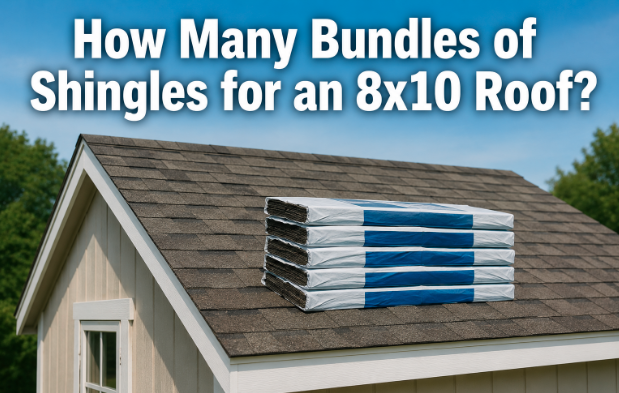
An 8×10 roof needs somewhere between 3 and 6 bundles of shingles. The honest answer depends on three things: how steep the roof is, how far the edge overhangs the walls, and whether you are covering one slope or two.
For a typical shed, playhouse, lean-to, or small porch roof with a 4/12 to 6/12 pitch and a normal overhang, plan on 5 bundles. That covers the field of the roof plus starter strips and ridge cap, with a little left over for mistakes.
If your structure is flatter or the overhang is small, you may only need 3 or 4 bundles. If the pitch is steep or the roof has hips and valleys, 6 is a safer target. The rest of this guide shows you exactly how to land on the right number for your own project.
What an 8×10 roof actually means
An 8×10 roof usually refers to the footprint, the flat area the structure covers, not the sloped surface you will be shingling. Eight feet by ten feet gives you 80 square feet of footprint.
A roofing square, the unit contractors price jobs by, is 100 square feet, so an 8×10 roof is a bit smaller than one full square. That is the main reason the bundle count for a job this size is so low: most calculators are built around full squares, and this project falls under one.
How to calculate bundles for your own roof
You do not need a contractor to work this out. Five steps get you a reliable number.
Start with the footprint. Multiply the two wall dimensions. For an 8×10 structure, that is 8 times 10, or 80 square feet.
Adjust for pitch. A sloped roof has more surface area than its flat footprint because the slope stretches the material. Roofers use a pitch multiplier to account for this. A steep roof does not just look bigger, it genuinely needs more shingles per square foot of footprint.
| Pitch (rise per 12 in) | Multiplier | Area for an 80 sq ft footprint |
| 2/12 | 1.014 | 81 sq ft |
| 4/12 | 1.054 | 84 sq ft |
| 6/12 | 1.118 | 89 sq ft |
| 8/12 | 1.202 | 96 sq ft |
| 10/12 | 1.302 | 104 sq ft |
| 12/12 | 1.414 | 113 sq ft |
Add the overhang. Shingles need to extend past the walls to shed water away from the siding and framing, typically 6 to 12 inches at the eaves and rakes. On a small roof, that overhang adds a surprising percentage of extra area, because the edge is long relative to the total size. A 1 foot overhang on all sides turns an 8×10 footprint into roughly 10×12, or 120 square feet, before you even apply the pitch multiplier.
Convert to squares, then bundles. Divide the total area by 100 to get squares, then multiply by 3, since standard three-tab and architectural shingles cover about 33.3 square feet per bundle, or three bundles per square. A 120 square foot area at a 4/12 pitch works out to about 126 square feet, or 1.26 squares, which comes to 3.8 bundles.
Round up and add waste. Bundles are sold whole, so round any fraction up. Then add 10 to 15 percent for cuts, overlap, and mistakes. On a small roof like this, that waste allowance often adds a full extra bundle rather than a fraction of one, since you cannot buy half a bundle.
Put together, an 8×10 roof at a common 4/12 to 6/12 pitch, with a normal overhang and a reasonable waste allowance, lands at 4 to 5 bundles for the shingle field itself.
A worked example
Say you are building an 8×10 shed with a 6/12 pitch and a 1 foot overhang on all sides, a common combination for a backyard storage shed. Start with the footprint, 80 square feet. Add the overhang and the working footprint becomes roughly 10 by 12, or 120 square feet.
Apply the 6/12 pitch multiplier of 1.118, and the sloped area comes to about 134 square feet. Divide by 100 to get 1.34 squares, then multiply by 3 bundles per square for 4.02 bundles.
Round up to 5 bundles, then add one more for starter strips and ridge cap, and you land on 6 bundles total for a fully finished, properly detailed roof. Drop the pitch to 3/12 and skip the overhang allowance, and the same shed could get by on 3 or 4.
The gap between those two scenarios shows why a single flat number does not work for every 8×10 roof. Measure your own structure rather than borrowing someone else’s total.
How to measure your roof before you buy
If the structure is already framed, measure the actual rafter length from the ridge (or the top plate on a single-slope roof) to the outer edge of the overhang, then multiply by the width of the roof.
This gives you the true sloped area directly, without needing a separate pitch multiplier, since the tape measure already follows the slope. If you are still in the planning stage and only know the wall dimensions, use the footprint-and-multiplier method described above instead.
Either approach gets you to the same place, a square footage figure you can divide by 33.3 to find your bundle count.
Does a single-slope roof need fewer bundles than a gable roof?
Not as much as you would expect. A single-slope, or shed-style, roof has one plane that covers the entire footprint. A gable roof splits that same footprint into two planes that meet at a ridge. Either way, the combined horizontal area you are covering is still close to the full footprint, so the raw square footage comes out similar.
What does change is the ridge itself: a gable roof needs ridge cap shingles running the length of the peak, while a single-slope roof does not. That difference usually amounts to a fraction of one extra bundle, not a full one, on a roof this size.
Hip roofs, with four sloped planes instead of two, need a bit more material still, since hips create extra cuts and slightly more waste.
Do starter strips and ridge cap change the count?
Yes, and this is where a lot of small roofs come up short. Starter strips run along the eaves to seal the first course of shingles and prevent wind from getting underneath them. Ridge cap covers the peak on a gable roof or the hip lines on a hip roof.
Some installers cut starter strips and ridge cap from full shingle bundles rather than buying a separate product, which uses up material faster than a simple area calculation suggests.
For an 8×10 roof, budget for roughly one extra bundle beyond your field calculation to cover starters and ridge cap, whether you buy dedicated starter and cap products or cut them from standard bundles.
Does the type of shingle change how many bundles you need?
It can. Three-tab shingles are thinner and typically pack 26 to 29 shingles per bundle, with three bundles covering one square. Architectural, or dimensional, shingles are thicker and heavier, usually 20 to 22 shingles per bundle, but most brands still cover one square with three bundles, so the bundle count for your 8×10 roof will not change much between the two.
GAF’s Timberline HDZ spec sheet lists 33.33 square feet of coverage per bundle, in line with the industry standard of three bundles per square. Premium or luxury shingles, styled to look like slate or wood shake, are the exception. Some of these need 4 or even 5 bundles to cover a single square, so a small roof shingled in a premium product could need 6 to 8 bundles instead of 4 to 5.
Always check the coverage listed on the specific product’s packaging or spec sheet before ordering, since it varies more than most people expect. IKO’s guide to bundle coverage confirms that most laminated shingle lines keep the standard three-bundles-per-square ratio, though a few specialty products do not.
Manufacturers keep that ratio consistent across most of their asphalt product lines on purpose, since it lets contractors estimate materials the same way regardless of which line a homeowner picks. It is only when you move into heavier, thicker, or specialty products that the ratio breaks from the norm, so a quick look at the label saves you from an under-order.
How much will your shingles weigh?
A standard bundle weighs 50 to 80 pounds, and architectural shingles run toward the heavier end of that range. Five bundles for an 8×10 roof adds up to 250 to 400 pounds total.
That is manageable for one or two people to carry up a ladder in stages, but it is worth planning the trips rather than trying to move everything at once, especially on a taller ladder or a steeper roof.
What if you order too few or too many?
Running short mid-job means a trip back to the supplier, possibly in a different dye lot that will not match the shingles already on the roof. Because of this, most experienced installers round up rather than down on a small job like this.
If you end up with unopened, unused bundles, many suppliers will accept a return, though some charge a restocking fee, so check the store’s policy before you buy. Buying one extra bundle beyond your calculated total is cheap insurance against a mismatched color or a stalled project.
Conclusion
Most 8×10 roofs need between 3 and 6 bundles of standard shingles, and 5 covers the typical shed, porch, or small outbuilding once pitch, overhang, starter strips, and ridge cap are all accounted for.
Measure your actual footprint and pitch, run the steps above, round up, and add one extra bundle as a buffer. That gets you a roof that is fully covered without a mid-project run to the supplier.
Frequently asked questions
Is an 8×10 roof the same as a roofing square?
No. A roofing square is 100 square feet, while an 8×10 footprint is 80 square feet, so an 8×10 roof is smaller than one full square before you factor in pitch and overhang.
How many shingles come in one bundle?
Standard three-tab bundles hold 26 to 29 shingles, while architectural bundles hold 20 to 22. Both types typically cover about 33.3 square feet per bundle, or one third of a roofing square.
Do I need extra shingles for a hip roof?
Yes, a little. Hip roofs have four sloped planes and more cut edges than a gable or single-slope roof, so add a bit more to your waste allowance, often an extra half bundle to a full bundle on a small roof.
Can I return unused, unopened bundles of shingles?
Many suppliers accept returns on unopened bundles, though some charge a restocking fee. Confirm the policy before you buy so you know your options if you end up with extra.
How many rolls of underlayment do I need for an 8×10 roof?
A roll of standard felt underlayment typically covers around 400 square feet, so one roll comfortably covers an 8×10 roof of any common pitch, with plenty left for a second small project.
Related Articles
Gap Between Wall and Ceiling: What Causes It and How to Fix It
What Is the Minimum Pitch for a Metal Roof?
How to Heat a Basement in Winter (Without Wasting Money)