



Introduction
If you have ever stood in a home improvement store staring at a wall of toilet seats, you have probably asked yourself the same question thousands of people search for every day: are toilet seats universal?
The short answer is that most toilet seats sold in North America follow a fairly standardized set of measurements, which means a large percentage of replacement seats will fit a large percentage of toilets without much trouble.
However, “mostly universal” is not the same as “always universal,” and there are enough exceptions out there that buying a seat without checking a few key measurements first can leave you with a product that wobbles, does not sit flush, or simply will not attach at all.
This guide walks through everything you need to know before buying a new toilet seat. We will cover the two main bowl shapes, the industry-standard measurements that make so many seats interchangeable, the situations where a seat will not simply drop into place, and a full walkthrough of how to measure your own toilet in a few minutes. By the end, you will be able to answer the question “are toilet seats universal” for your own bathroom with total confidence, rather than relying on guesswork at the store.
Toilet seat shopping matters more than people expect. A poorly fitted seat can rock side to side, pinch skin, scratch porcelain, or simply look awkward perched on the bowl. A well-fitted seat, on the other hand, sits flush, stays stable, and can completely change the comfort and appearance of a bathroom during a renovation or a simple upgrade.
Understanding Toilet Seat Shapes
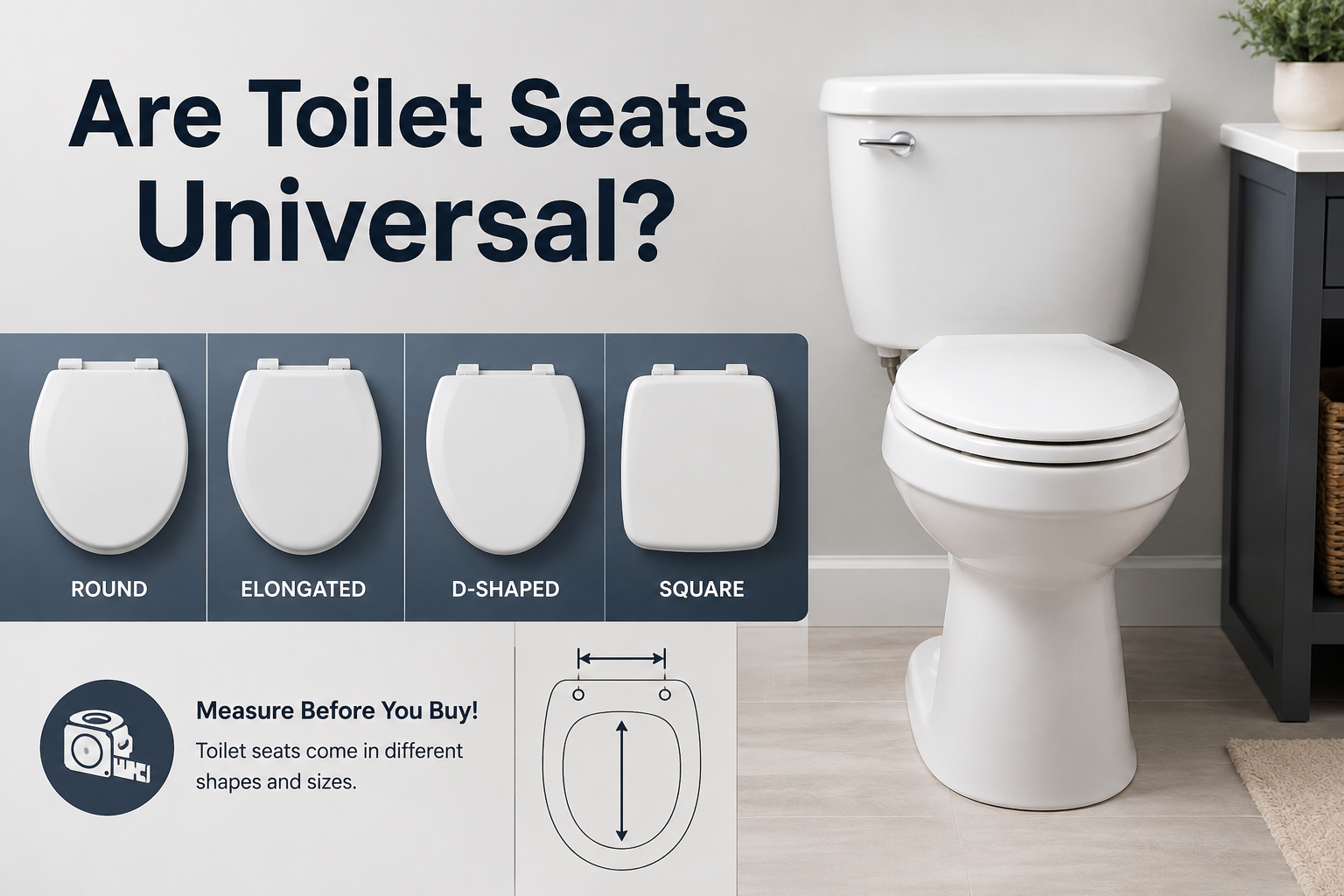
Before talking about universal fit, it helps to understand that toilet bowls are manufactured in only two common shapes in most residential markets. Almost every seat compatibility question comes down to correctly identifying which of these two shapes you have.
Round Bowls
A round bowl is shorter front to back and has a rounded front edge that forms a near-perfect circle when viewed from above. Round bowls are common in smaller bathrooms, older homes, and half-baths where space is limited. They typically measure around 16.5 inches from the mounting bolts to the front edge of the bowl.
Elongated Bowls
An elongated bowl is oval-shaped and extends farther forward, usually measuring around 18.5 inches from the mounting bolts to the front tip. Elongated bowls are more common in modern homes and are often considered more comfortable for adult users, which is why many building codes now favor them in public restrooms.
How to Measure Your Toilet Bowl Shape at Home
Measuring your own bowl shape takes less than two minutes. Sit a tape measure at the center of the two bolts holding the current seat in place, then measure straight forward to the outer edge of the bowl. If the measurement lands close to 16.5 inches, you have a round bowl. If it lands closer to 18.5 inches, you have an elongated bowl. This single measurement eliminates the single biggest reason replacement seats fail to fit.
Standard Sizing Explained
The reason so many people assume toilet seats are universal is that the plumbing fixture industry in the United States and Canada has quietly agreed on a small set of standard dimensions for decades. This standardization is what allows big retailers to stock a handful of seat models that fit the vast majority of toilets sold across many different brands.
Bolt Hole Spacing
The most important standardized measurement is the distance between the two mounting bolt holes at the back of the bowl. In the overwhelming majority of residential toilets, this spacing measures 5.5 inches center to center. Because this spacing is so consistent, most replacement seats are manufactured with adjustable or slotted hinge posts designed to match that exact distance.
Seat Width and Length Averages
Beyond bolt spacing, seat width tends to hover around 14 to 14.5 inches regardless of shape, while length is the main variable that changes between round and elongated designs. The table below summarizes typical dimensions for quick reference.
| Measurement | Round Bowl | Elongated Bowl |
|---|---|---|
| Bolt hole spacing | 5.5 inches | 5.5 inches |
| Length (bolts to front edge) | Approx. 16.5 inches | Approx. 18.5 inches |
| Overall seat width | Approx. 14 inches | Approx. 14.5 inches |
| Common use case | Smaller bathrooms, older homes | Modern homes, public restrooms |
Why Manufacturers Follow Similar Templates
Toilet and seat manufacturers benefit from following shared dimensions because it widens their potential customer base and reduces returns. A seat brand that only fit its own toilets would struggle to compete against brands offering universal-fit products that work across dozens of toilet manufacturers. This shared incentive across the industry is the real driver behind the standardization that makes the phrase “universal fit” appear on so much packaging.
What Makes Seats “Universal”
The word “universal” on a toilet seat box is a marketing term built on top of the standardization described above. It is a genuinely useful shorthand, but it is worth understanding exactly what it does and does not promise.
Standardized Plumbing Fixture Dimensions in the US and Canada
Because bolt spacing and general bowl proportions have stayed consistent across most North American manufacturers for generations, a seat labeled universal is really just a seat built to match that shared template rather than one specific brand’s toilet.
Adjustable Hinges and Mounting Brackets
Many modern seats include hinge posts that slide inward or outward slightly, along with brackets that can shift within a small range. This built-in flexibility is what allows a single seat model to accommodate minor variations between toilets that are all technically within the standard range.
Universal-Fit Product Lines from Major Brands
Most major seat manufacturers sell a “universal fit” line specifically engineered to cover both round and elongated shapes in some cases, or at least to fit any bowl within the standard bolt spacing and length ranges. These product lines are the reason casual buyers can usually walk into a store, pick up a seat, and have it work at home.
Exceptions to Universal Fit
Universal fit is a strong general rule, not an absolute guarantee. A meaningful number of toilets fall outside the standard template, and it is worth knowing which categories to watch for.
European and Asian Toilet Models
Toilets manufactured for European, Japanese, and other international markets frequently use different bolt spacing, bowl proportions, or mounting systems entirely. A seat bought locally will often not fit an imported toilet, and vice versa.
Wall-Mounted and Specialty Toilets
Wall-hung toilets, along with some low-profile or compact designs, often use custom bowl shapes or mounting hardware that does not match the standard floor-mounted template, making off-the-shelf universal seats a poor match.
Antique or Discontinued Toilet Models
Toilets manufactured decades ago, especially before wide industry standardization took hold, can have unusual bolt spacing or bowl shapes that no longer match anything currently sold in stores.
Designer or Luxury Toilets with Custom Shapes
High-end toilets, particularly those from boutique or architectural brands, sometimes feature sculpted or asymmetrical bowl designs built specifically for a matching proprietary seat, which limits compatibility with generic replacements.
One-Piece vs Two-Piece Toilets
While the toilet’s construction style itself does not usually change seat compatibility, some one-piece designs pair with integrated or slightly customized bowl shapes, so it is still worth double-checking measurements rather than assuming universal fit applies automatically.
How to Measure Your Toilet Before Buying
Taking two or three quick measurements before shopping removes almost all of the risk involved in buying a new seat. This process works whether you are shopping in person or ordering online.
Tools Needed
All that is required is a flexible tape measure and a couple of minutes. No specialized tools are necessary.
Step-by-Step Measuring Guide
First, remove or lift the current seat if it is in the way. Second, locate the two bolts at the back of the bowl. Third, measure the distance between the centers of those two bolts. Fourth, measure from the midpoint between the bolts straight forward to the front tip of the bowl. Finally, note both numbers before heading to the store or shopping online.
Bolt Spacing Measurement
As covered earlier, most bowls measure 5.5 inches between bolt centers. If your measurement differs noticeably from this, you likely have a specialty toilet and should look for seats explicitly labeled for that spacing.
Bowl Length Measurement
This measurement tells you whether you need a round or elongated seat. Numbers close to 16.5 inches indicate round, while numbers close to 18.5 inches indicate elongated.
Common Measurement Mistakes to Avoid
The most frequent mistakes include measuring from the edge of the bolt rather than its center, measuring the current seat instead of the actual bowl, and forgetting to account for a tank that overhangs the back of the bowl slightly, which can throw off length measurements if not accounted for carefully.
Types of Toilet Seats
Once shape and size are settled, the next decision is which type of seat material and feature set best fits your household. This decision does not affect universal fit but does affect comfort, durability, and price.
Plastic vs Wood vs Cushioned Seats
Plastic seats are lightweight, affordable, and resistant to moisture damage. Wood seats offer a warmer feel and a more traditional look but can be more sensitive to prolonged moisture exposure. Cushioned or padded seats add extra comfort but tend to wear out faster in high-traffic bathrooms.
Soft-Close Seats
Soft-close seats use a hinge mechanism that slows the lid and seat as they fall, preventing the loud slam associated with older designs. These have become extremely popular in recent years due to both convenience and noise reduction.
Bidet-Integrated Seats
Bidet seats replace the standard seat entirely with a unit that includes washing functions, often requiring a nearby water line and sometimes an electrical outlet. These seats still generally follow standard bolt spacing, but overall dimensions can vary more than basic seats.
Heated Seats
Heated seats, often bundled with bidet functionality, use a low-voltage heating element to warm the surface. These require an electrical connection and are worth planning for in advance if your bathroom does not already have a nearby outlet.
Quick-Release Seats for Easy Cleaning
Quick-release seats use a hinge system that allows the entire seat to lift off without tools, making it much easier to clean around the bolts and hinge area thoroughly.
Installation Considerations
Even a perfectly sized seat needs proper installation to perform well. Fortunately, most seats are designed for straightforward, tool-light installation.
Standard Bolt-On Installation
Most seats attach using two bolts that pass through the hinge posts and into the existing holes in the bowl, secured underneath with wing nuts or a similar fastener.
Adjustable vs Fixed Hinges
Adjustable hinges allow slight side-to-side or front-to-back movement to fine-tune alignment, while fixed hinges are set at one position and rely entirely on matching the bowl’s exact bolt spacing.
Tools Required for Installation
Many modern seats can be installed by hand, though a screwdriver or small wrench is sometimes needed for older bolt styles or particularly stubborn wing nuts.
Common Installation Errors
The most common issues include overtightening bolts, which can crack porcelain, failing to center the seat evenly on both sides, and forgetting to insert rubber washers or bumpers where required, which can lead to a wobbly feel even with a correctly sized seat.
Buying Guide
With measurements in hand, choosing the right seat becomes a much simpler process of matching numbers and features rather than guessing.
How to Choose the Right Seat for Your Toilet
Start with your measured shape and bolt spacing, then narrow choices by material, closing mechanism, and any additional features such as heating or bidet function.
Checking Manufacturer Compatibility Charts
Many toilet manufacturers publish compatibility charts online listing which seat shapes and models fit their toilet lines, which can be a helpful cross-reference, especially for less common toilet brands.
Reading Product Descriptions Correctly
Pay close attention to whether a listing specifies round or elongated, and check the listed bolt spacing rather than assuming every product is a universal fit simply because the word appears somewhere in the title.
When to Buy From the Same Brand as Your Toilet
For specialty, imported, or older toilets, buying directly from the same brand as the toilet itself, or a seat explicitly listed as compatible with that model, is the safest way to avoid a fitting mismatch.
Troubleshooting Fit Issues
Even with careful measuring, occasional fit issues can happen. Most are easy to resolve without returning the product.
Seat Too Small or Too Large
If a seat appears too short or too long for the bowl, double check that the correct shape, round versus elongated, was selected in the first place, since this is the most common cause of an obvious size mismatch.
Misaligned Bolt Holes
If bolts do not line up cleanly, check whether the seat has adjustable hinge posts that can slide to compensate for minor spacing differences.
Wobbling or Shifting Seats
A wobbling seat is usually caused by loose bolts, missing rubber washers, or an uneven bowl surface, rather than an incorrect size, and can often be fixed by simply retightening hardware evenly on both sides.
Returning or Exchanging a Mismatched Seat
If a seat genuinely does not fit after checking shape, bolt spacing, and hardware, most retailers accept returns or exchanges as long as the seat is unused and undamaged, so keeping the original packaging until installation is confirmed successful is a smart precaution.
Frequently Asked Questions
Are all toilet seat colors and finishes interchangeable? Yes, color and finish have no effect on fit. Any color option within the correct shape and bolt spacing will install the same way.
Can one seat fit both round and elongated bowls? Generally no. While some adjustable or specialty seats claim dual compatibility, the vast majority of seats are built specifically for one shape or the other.
Do all toilet seats use the same bolts? Most use the standard 5.5 inch spacing, but bolt length, thread style, and mounting hardware can vary slightly, so using the bolts included with a new seat is usually the safest approach.
Are toilet seats interchangeable between brands? In most cases yes, thanks to shared industry standards, though specialty, imported, or older toilets may require brand-specific seats as discussed earlier in this guide.
Conclusion
So, are toilet seats universal? For the majority of standard residential toilets in North America, the answer is yes, thanks to decades of shared industry standards around bolt spacing and bowl shape.
At the same time, exceptions involving imported models, wall-mounted toilets, older fixtures, and designer bathroom suites are common enough that a quick measurement before buying is always worth the extra couple of minutes.
By checking your bowl shape, confirming bolt spacing, and reading product listings carefully, you can walk into any store or shop online with confidence that the seat you choose will fit properly the first time.
Related Articles
Why Is My Toilet Bubbling? Causes, Fixes & When to Call a Plumber
How Much Do Kitchen Cabinets Cost in 2026? Complete Pricing Guide
How to Install 12×12 Ceiling Tiles With Staples?
Is Ceiling Ghosting Dangerous? What Those Dark Streaks Actually Mean