


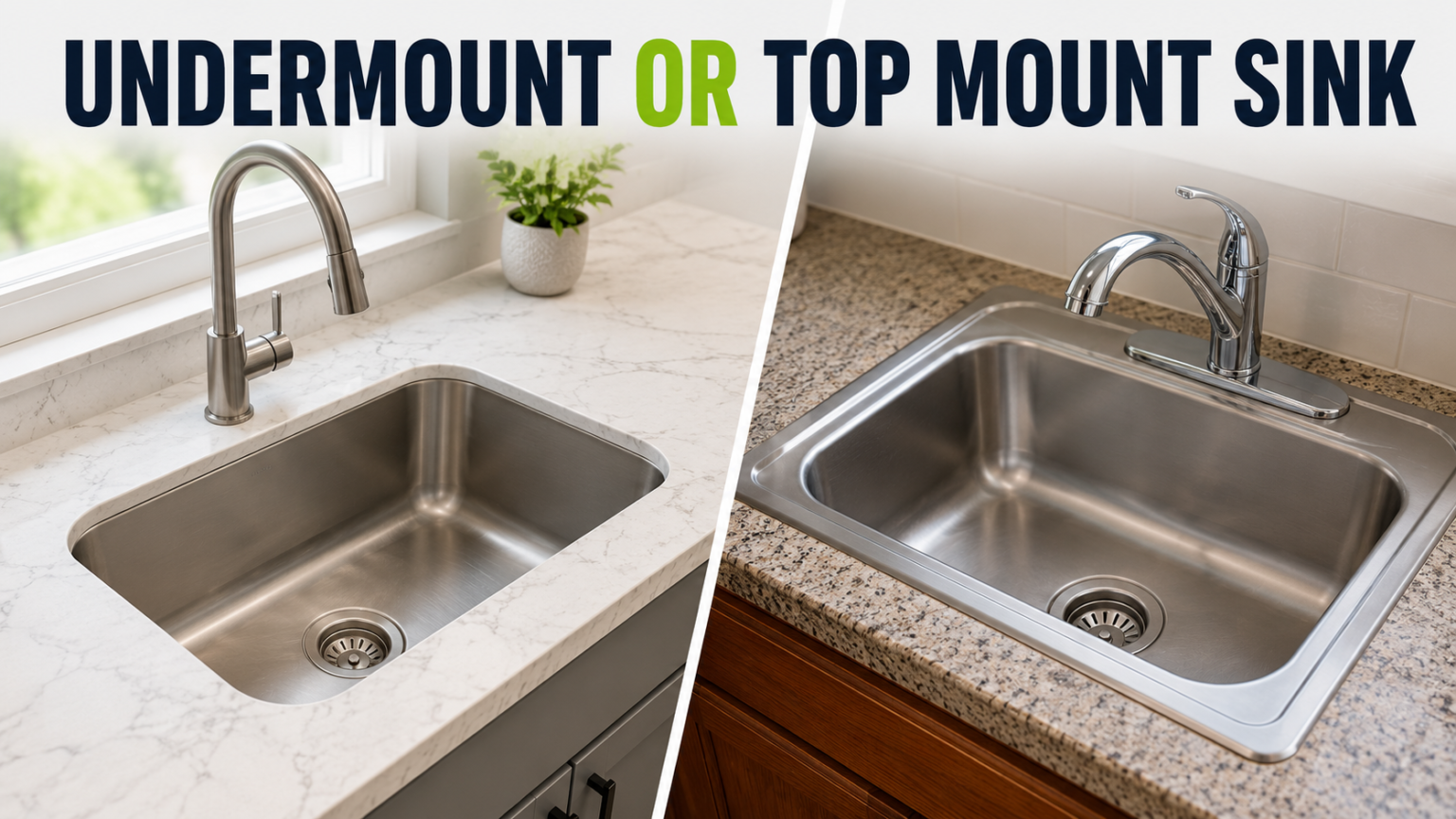
If you’re remodeling your kitchen or bathroom, one of the first decisions you’ll run into is choosing between an undermount or top mount sink. It might sound like a small detail, but the mounting style you pick affects how your countertop looks, how easy your sink is to clean, how much you’ll spend, and even how long the whole setup will last.
Both styles do the same basic job — holding water and helping you wash dishes or your hands — but they get there in very different ways. An undermount sink hides beneath the counter for a clean, modern look, while a top mount sink sits above the counter and is held in place by its own rim. Neither one is “better” in every situation; the right choice really depends on your budget, your countertop material, and the style you’re going for.
This guide walks through everything you need to know — from how each sink is built, to installation, cost, cleaning, and which countertops pair best with each — so you can make a confident, informed decision.
What is an Undermount Sink?
An undermount sink is exactly what it sounds like: a sink that’s mounted underneath the countertop rather than on top of it. The edge of the countertop is cut precisely to match the shape of the sink, and the sink is then attached from below using clips, brackets, and strong adhesive or epoxy.
Because there’s no rim sitting above the counter, the transition between the countertop and the sink is smooth and almost seamless. This creates a sleek, modern appearance that many homeowners love, especially in kitchens with stone or solid-surface counters.
Undermount sinks are commonly made from:
- Stainless steel
- Granite composite
- Fireclay
- Cast iron with enamel coating
You’ll typically find undermount sinks in kitchens with granite, quartz, or marble countertops, since these solid surfaces can support the weight and precise cutout required. They’re also popular in bathrooms where a minimalist, spa-like look is desired.
What is a Top-Mount (Drop-In) Sink?
A top-mount sink, often called a drop-in sink, is installed by lowering it into a matching hole cut in the countertop from above. A visible rim, or lip, runs around the edge of the sink and rests directly on top of the counter, which is what actually holds the sink in place.
This is the more traditional and widely used style, largely because it’s simpler to install and works with almost any countertop material.
Common materials for top-mount sinks include:
- Stainless steel
- Porcelain
- Cast iron
- Acrylic and composite materials
Top-mount sinks are a common choice in budget-friendly kitchens, rental properties, and homes with laminate or tile countertops. They’re also a favorite for DIY renovators, since installation doesn’t require specialized tools or professional-grade precision.
Key Differences at a Glance
Here’s a quick side-by-side comparison to help you visualize the differences before diving deeper:
| Feature | Undermount Sink | Top-Mount Sink |
|---|---|---|
| Appearance | Seamless, modern, hidden edge | Visible rim, more traditional look |
| Installation | Complex, usually professional | Simple, DIY-friendly |
| Cost | Higher (sink + labor) | Lower overall cost |
| Cleaning | Easy to wipe crumbs directly into sink | Rim can trap dirt and grime |
| Countertop compatibility | Needs solid surface (granite, quartz) | Works with almost any countertop |
| Durability | Very sturdy when installed correctly | Long-lasting, simple support structure |
| Best for | Modern kitchens, high-end remodels | Budget renovations, rentals, DIY projects |
Pros and Cons of Undermount Sinks
Undermount sinks are often seen as the more premium option, and for good reason. Because the sink sits flush beneath the counter, cleaning becomes much easier — you can simply wipe crumbs and spills straight off the counter and into the sink without anything catching on a rim. The seamless design also gives kitchens and bathrooms a more polished, contemporary feel that many buyers find appealing, which can even boost resale value in some cases.
That said, undermount sinks come with real trade-offs. They tend to cost more, both for the sink itself and for the labor involved, since installation requires precise cutting and strong structural support. They also depend heavily on having a solid, sturdy countertop material — you generally can’t install an undermount sink under laminate, since the exposed particleboard edge would be prone to water damage.
Pros and Cons of Top-Mount Sinks
Top-mount sinks shine when it comes to affordability and simplicity. Since the rim rests on top of the counter, installation doesn’t require the same level of precision, and many homeowners install these sinks themselves without hiring a professional. They also work with virtually any countertop material, making them a flexible choice for a wide range of budgets and home styles.
The main downside is the visible seam where the rim meets the counter. Over time, this seam can collect crumbs, grime, and moisture, which means a bit more scrubbing during cleanup. Aesthetically, top-mount sinks also tend to look a little less sleek compared to the seamless undermount style, though many modern drop-in designs have narrowed this gap significantly.
Cost Comparison
Cost is often the deciding factor when choosing between an undermount or top mount sink, so it’s worth breaking down where the money actually goes.
Sink price range: Top-mount sinks are generally the more affordable option upfront, with basic stainless steel models available at a lower price point. Undermount sinks, especially those made from granite composite or fireclay, tend to sit at a higher price tier.
Installation and labor cost: This is where the gap widens the most. Top-mount sinks can often be installed by a confident DIYer in an afternoon, keeping labor costs low or nonexistent. Undermount sinks almost always require a professional, since the countertop must be cut and finished precisely, and the sink needs to be securely bonded from underneath.
Long-term maintenance cost: Undermount sinks generally have lower ongoing maintenance costs since there’s no rim or caulk line to reseal repeatedly. Top-mount sinks may need occasional recaulking around the rim to prevent water from seeping underneath.
Installation Process Overview
Undermount sink installation typically follows these steps: the countertop is measured and a precise cutout is made to match the sink’s dimensions, the sink is positioned beneath the counter, and clips or brackets combined with waterproof adhesive secure it in place. The edges are then finished and sealed to prevent moisture from getting between the sink and the counter. Because of the precision involved, this process is almost always handled by a professional installer.
Top-mount sink installation is more straightforward: a hole is cut into the countertop, the sink is lowered into place from above, and clips underneath the counter hold it secure while a bead of caulk or plumber’s putty seals the rim against the surface. This process can often be completed without specialized equipment, which is why it’s a favorite for home improvement projects.
Maintenance and Cleaning Differences
Day-to-day cleaning is one of the most noticeable differences between these two sink styles. With an undermount sink, wiping down the counter is effortless — there’s no rim to work around, so crumbs and liquid can be swept directly into the basin. This also means less buildup of grime in hard-to-reach corners.
Top-mount sinks require a little more attention around the rim, where food particles, soap scum, and moisture can accumulate over time. Periodically checking and refreshing the caulk seal around the edge helps prevent water damage to the countertop underneath, particularly with laminate surfaces.
Which Countertops Work Best With Each
Not every countertop material supports both mounting styles equally well.
Best countertops for undermount sinks:
- Granite
- Quartz
- Marble
- Solid-surface materials (like Corian)
Best countertops for top-mount sinks:
- Laminate
- Tile
- Budget-friendly composite materials
- Any surface where an exposed edge isn’t a concern
If your countertop is laminate or tile, a top-mount sink is usually the practical choice, since undermount installation on these materials can lead to water damage over time.
Durability and Lifespan
Both sink styles can last for decades when installed and maintained properly. Undermount sinks rely on strong adhesive bonds and clips, so proper installation is critical — a poorly installed undermount sink can loosen over time under the weight of dishes and water. Top-mount sinks distribute their weight through the rim resting on the countertop, which is a simpler and generally very reliable support method.
In terms of material durability, stainless steel, cast iron, and fireclay tend to hold up well in either mounting style, while the mounting method itself has more to do with long-term stability than the material choice alone.
Which One Should You Choose? (Decision Guide)
Choosing between an undermount or top mount sink really comes down to a few personal factors:
If your priority is a sleek, modern look and you already have (or plan to install) a solid stone countertop, an undermount sink is likely the better fit. If you’re working with a tighter budget, prefer a DIY-friendly project, or have a laminate countertop, a top-mount sink makes more practical sense.
Homeowners planning to sell in the near future might lean toward undermount sinks, since buyers often associate them with updated, higher-end kitchens. On the other hand, if you’re renovating a rental property or a secondary bathroom where budget matters more than aesthetics, a top-mount sink offers excellent value without sacrificing function.
Frequently Asked Questions (FAQs)
Can I switch from a top-mount to an undermount sink? Yes, but it usually requires replacing the countertop as well, since the cutout and edge finishing needed for an undermount sink are different from a top-mount cutout.
Is an undermount sink worth the extra cost? For many homeowners, yes — especially if easy cleaning and a modern look are priorities. However, if budget is a bigger concern, a top-mount sink still performs the same core function well.
Do undermount sinks leak more than top-mount sinks? Not inherently. Leaks are more often the result of poor installation than the mounting style itself. A properly installed undermount sink is just as watertight as a properly installed top-mount sink.
Which option is better for resale value? Undermount sinks are often viewed as a more premium feature, which can make kitchens feel more updated to potential buyers, though this varies by market and overall kitchen style.
Conclusion
At the end of the day, deciding between an undermount or top mount sink comes down to balancing style, budget, and practicality. Undermount sinks offer a clean, modern appearance and easier everyday cleaning, but they come with a higher price tag and require a compatible countertop. Top-mount sinks are budget-friendly, versatile, and easy to install, making them a smart choice for a wide range of homes and renovation budgets.
There’s no universally “right” answer — only the right answer for your kitchen, your countertop, and your budget. Whichever you choose, both sink styles have stood the test of time for good reason: they’re reliable, functional, and ready to handle everyday life.
Related Articles
How Much Does a Toilet Weigh? Full Weight Guide by Type & Material
How to Measure Roof Slope: A Simple Step-by-Step Guide
How to Cover Up Popcorn Ceiling: 6 Easy Methods for a Modern Look
How To Get Rid Of Mold In Basement? Complete Step-by-Step Guide