


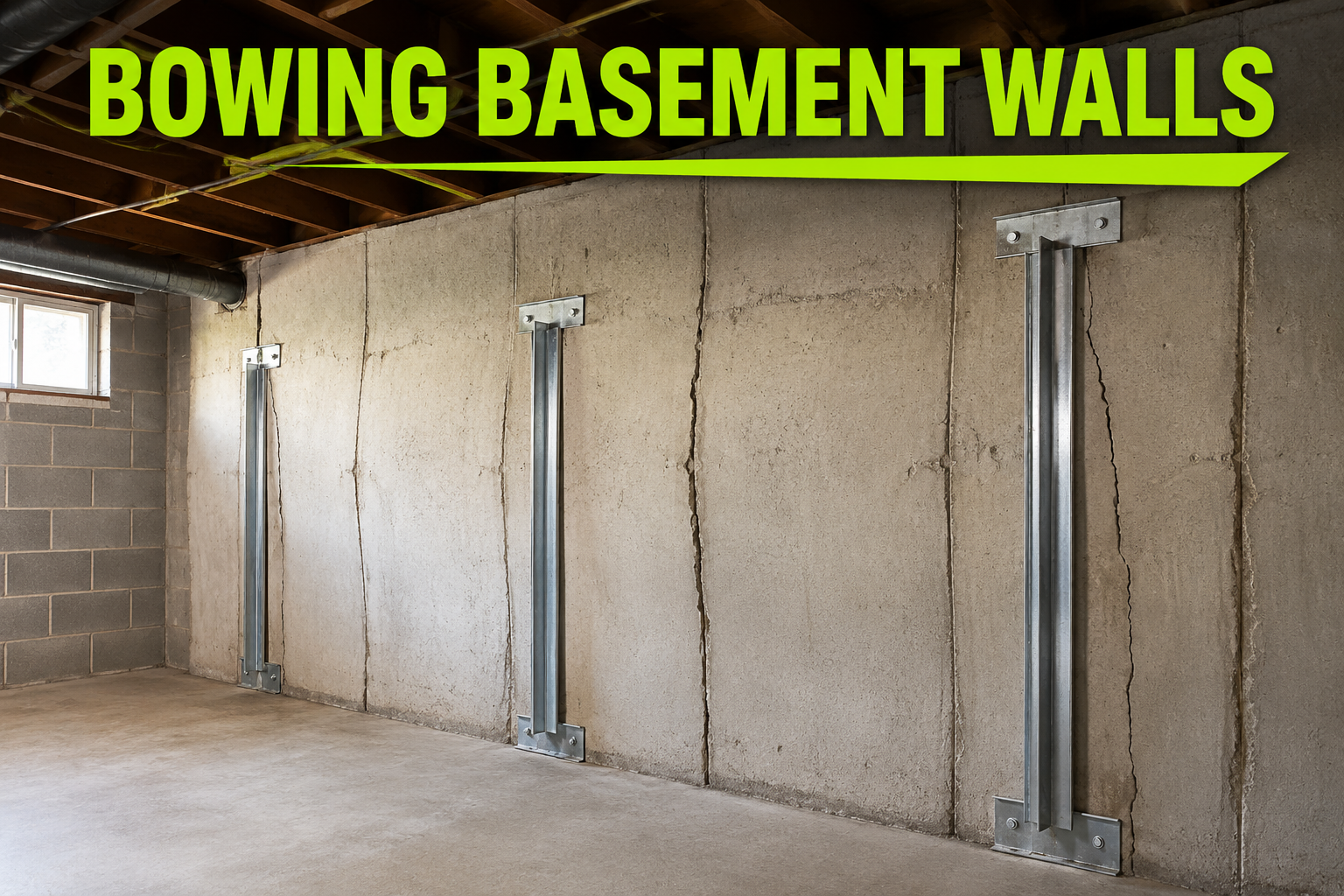
If you’ve noticed a curve, bulge, or inward lean in your basement wall, you’re not imagining things. Bowing basement walls are one of the most common — and most serious — structural problems a homeowner can face. Unlike a simple hairline crack that might just be cosmetic, a bowing wall usually points to ongoing pressure that is slowly pushing your foundation out of shape. Left unaddressed, it can lead to major structural damage, water intrusion, and in extreme cases, wall failure.
This guide walks through everything you need to know about bowing basement walls — what causes them, how to recognize the warning signs, how contractors measure severity, and the repair methods that actually solve the problem instead of just masking it.
What Does a Bowing Wall Actually Mean
A bowing wall is a foundation wall that has started to curve inward, typically along its horizontal midpoint, because of constant outside pressure. It’s different from a wall that is simply cracked or one that has settled unevenly into the ground.
- Bowing refers to a curved, inward deformation, almost like the wall is being bent by an invisible hand pressing from outside.
- Cracking can happen with or without bowing, and doesn’t always mean the wall has moved out of position.
- Settling usually refers to vertical movement, where part of the foundation sinks lower than the rest, rather than the wall curving inward.
Visually, a bowing wall often looks like it has a slight belly or arch when viewed from the side, most noticeable around the center height of the wall. You can sometimes confirm this by holding a long level or straightedge against the wall — if there’s a visible gap in the middle, the wall is bowing.
Common Causes of Bowing Basement Walls
Bowing rarely happens overnight. It’s almost always the result of sustained pressure building up over months or years. Here are the most frequent causes:
Hydrostatic pressure is the leading culprit. When groundwater builds up in the soil surrounding your foundation, it pushes against the basement walls. Over time, this constant force can gradually bend the wall inward.
Poor or clogged drainage systems make hydrostatic pressure worse. If gutters are clogged, downspouts are too short, or the ground slopes toward your house instead of away from it, water collects near the foundation instead of draining off.
Expansive clay soil is another major factor, especially in regions where the soil naturally contains a lot of clay. This type of soil absorbs water and swells significantly, then shrinks again as it dries — this constant expansion and contraction puts repeated stress on foundation walls.
Frost heave affects homes in colder climates. When moisture in the soil freezes, it expands, and that expansion can exert tremendous lateral force against basement walls, especially in shallow foundations.
Poor original construction can leave a foundation more vulnerable from the start. Thin walls, weak concrete mixes, or inadequate reinforcement all reduce a wall’s ability to resist outside pressure.
Heavy loads near the foundation — such as parked vehicles, driveways, patios, sheds, or even large trees — add extra downward and lateral pressure to the soil right next to your walls.
Age and natural wear also play a role. Concrete and masonry weaken over decades, making older foundations more susceptible to bowing even under normal soil pressure.
Types of Basement Walls and How Each Reacts
Not all basement walls are built the same way, and the material affects how — and where — bowing tends to occur.
| Wall Type | How It Typically Bows | Vulnerability Level |
|---|---|---|
| Poured concrete | Tends to crack horizontally before bowing; bows as one continuous curve | Moderate |
| Concrete block (CMU) | Bows along mortar joints; often shows stair-step cracking first | High |
| Brick and stone | Bows unevenly; mortar joints separate, wall may bulge in sections | High |
Concrete block walls are generally the most prone to bowing because the mortar joints between blocks are weaker than the blocks themselves, giving hydrostatic pressure a natural point of failure. Poured concrete walls are more resistant but not immune, especially if reinforcement (rebar) was minimal during construction.
Warning Signs and Symptoms
Catching a bowing basement wall early can save you thousands of dollars in repair costs. Watch for these signs:
- Horizontal cracks running across the wall, especially near the mid-height
- Stair-step cracks in block or brick walls
- A visible inward curve when viewed from the side or checked with a straightedge
- Doors and windows upstairs that suddenly stick or don’t close properly
- Gaps forming between the wall and the floor or ceiling
- Water seepage or persistent dampness tracking along cracks
- A wall that feels like it’s leaning when pushed on gently
Any one of these signs on its own might not be alarming, but a combination of several — especially horizontal cracking paired with visible curvature — is a strong signal that the wall is actively bowing.
How to Measure the Severity
Foundation professionals typically categorize bowing basement walls into three severity levels, usually measured by how many inches the wall has moved out of plumb (vertical alignment).
Minor bowing usually means less than one inch of inward movement. At this stage, the wall may just need monitoring along with drainage improvements to prevent further movement.
Moderate bowing typically falls between one and two inches of displacement. This usually calls for reinforcement, such as carbon fiber straps or steel bracing, to stabilize the wall and stop further bowing.
Severe bowing is anything beyond two inches, or any wall showing signs of imminent failure such as large cracks, shifting blocks, or visible instability. This level often requires wall anchors, tiebacks, or in the worst cases, full excavation and rebuilding.
If you’re unsure which category your wall falls into, it’s always best to have a structural engineer or foundation specialist assess it in person rather than guessing based on appearance alone.
Is a Bowing Wall Dangerous?
Yes — a bowing basement wall is a genuine structural concern, not just an aesthetic flaw. If left untreated, continued pressure can eventually cause the wall to crack through completely or collapse, which is both a safety hazard and an extremely costly repair.
Beyond the immediate safety risk, bowing walls can significantly affect your home’s value. Most buyers and home inspectors flag foundation issues immediately, and a bowing wall can scare off potential buyers or trigger a renegotiation of the sale price. It can also affect your homeowners insurance, as many policies exclude foundation damage caused by soil pressure or water, meaning repairs often come out of pocket.
Common Repair Methods
The right repair method depends on the severity of the bowing, the wall material, and your budget. Here’s a breakdown of the most widely used solutions.
Carbon fiber reinforcement straps are one of the most popular options for minor to moderate bowing. These are epoxied vertically to the interior wall surface and act like a tension band, preventing further inward movement without taking up much space.
Steel I-beam bracing involves installing vertical steel beams along the interior of the wall, anchored at the floor and ceiling joists. These beams resist ongoing pressure and can sometimes be tightened over time to gradually straighten the wall.
Wall anchors use a system of interior plates connected by a rod to anchor plates buried in stable soil outside the foundation. Over time, these anchors can often be tightened to slowly pull a bowing wall back toward its original position.
Helical tiebacks work similarly to wall anchors but use helical (screw-shaped) plates driven deep into the soil, offering strong holding power even in looser soil conditions.
Full wall excavation and rebuild is reserved for severe cases where the wall is too damaged to reinforce safely. This involves removing the damaged wall entirely and constructing a new one, often with improved drainage and reinforcement built in.
Shotcrete or wall resurfacing may be used for minor cosmetic and structural touch-ups, though it’s typically paired with another reinforcement method rather than used alone for genuine bowing.
Prevention Tips
Preventing future bowing — or stopping existing minor bowing from worsening — usually comes down to controlling water and pressure around your foundation.
- Improve exterior grading so the ground slopes away from your foundation
- Clean gutters regularly and extend downspouts at least 5–6 feet from the house
- Install a French drain system to redirect groundwater away from the walls
- Add or maintain a sump pump to manage water buildup around the foundation
- Avoid parking vehicles or building structures too close to basement walls
- Keep large trees and their root systems a safe distance from the foundation
These preventive steps won’t fix an already-bowing wall, but they significantly reduce the pressure that causes bowing in the first place, and they’re essential alongside any structural repair.
Cost Considerations
Repair costs for bowing basement walls vary widely depending on severity, wall length, and the method used. Here’s a general cost comparison:
| Repair Method | Typical Cost Range | Best For |
|---|---|---|
| Carbon fiber straps | $350–$1,000 per strap | Minor to moderate bowing |
| Steel I-beams | $500–$1,200 per beam | Moderate bowing |
| Wall anchors | $600–$1,500 per anchor | Moderate to severe bowing |
| Helical tiebacks | $700–$1,800 per tieback | Severe bowing, poor soil |
| Full wall rebuild | $15,000–$40,000+ | Severe or failing walls |
Factors that influence the final price include the length and height of the affected wall, how difficult the site is to access, local labor rates, and whether drainage improvements are needed alongside the structural repair. Because of the risks involved with foundation work, DIY repair is not recommended for anything beyond minor drainage fixes — bowing wall reinforcement requires precise engineering to be done safely and effectively.
How to Choose a Foundation Repair Contractor
Since foundation repair is a major investment, choosing the right contractor matters as much as choosing the right repair method. When evaluating contractors, ask:
- Do you offer a free inspection and written estimate?
- Is a structural engineer involved in assessing the wall?
- What warranty do you offer on the repair?
- Can you provide references from similar past projects?
- Are you licensed and insured for foundation work in this area?
Be cautious of any contractor who pushes for an immediate decision, skips a proper inspection, or can’t clearly explain why they’re recommending one method over another. A trustworthy contractor will walk you through the severity level of your wall and explain their reasoning in plain terms.
Frequently Asked Questions
Can a bowing wall fix itself? No. Bowing walls do not correct themselves naturally. Without intervention, the pressure causing the bow typically continues, and the wall tends to worsen over time rather than stabilize on its own.
How urgent is repair? It depends on severity. Minor bowing can often be monitored short-term while drainage issues are addressed, but moderate to severe bowing should be treated as urgent, since delays increase both the risk and the eventual repair cost.
Does homeowners insurance cover this? Usually not. Most standard homeowners insurance policies exclude foundation damage caused by soil pressure, water, or gradual settling, since these are considered maintenance issues rather than sudden covered events. Always check your specific policy for details.
Can I sell a house with a bowing wall? Yes, but it will likely come up during inspection and can affect negotiations. Many sellers choose to repair the wall before listing, while others disclose the issue and adjust the price accordingly.
Conclusion
Bowing basement walls are a serious structural issue that shouldn’t be ignored, but they’re also very treatable when caught early and repaired correctly. Understanding the causes — from hydrostatic pressure to expansive soil — helps you take preventive steps, while recognizing the early warning signs gives you the chance to act before the problem becomes severe.
Whether your wall needs simple carbon fiber reinforcement or a full rebuild, the key is getting a proper inspection from a qualified professional who can accurately assess the severity and recommend the right fix.
If you suspect your basement wall is bowing, don’t wait for it to get worse — schedule an inspection with a foundation specialist to get a clear picture of what’s happening and what it will take to fix it.
Related Articles
Why Does My Bathroom Sink Smell Like Rotten Eggs? (Causes & Easy Fixes)
How To Clean Cork Flooring? A Complete Step-by-Step Guide
How To Restain Kitchen Cabinets? Step-By-Step Guide For Beginners