


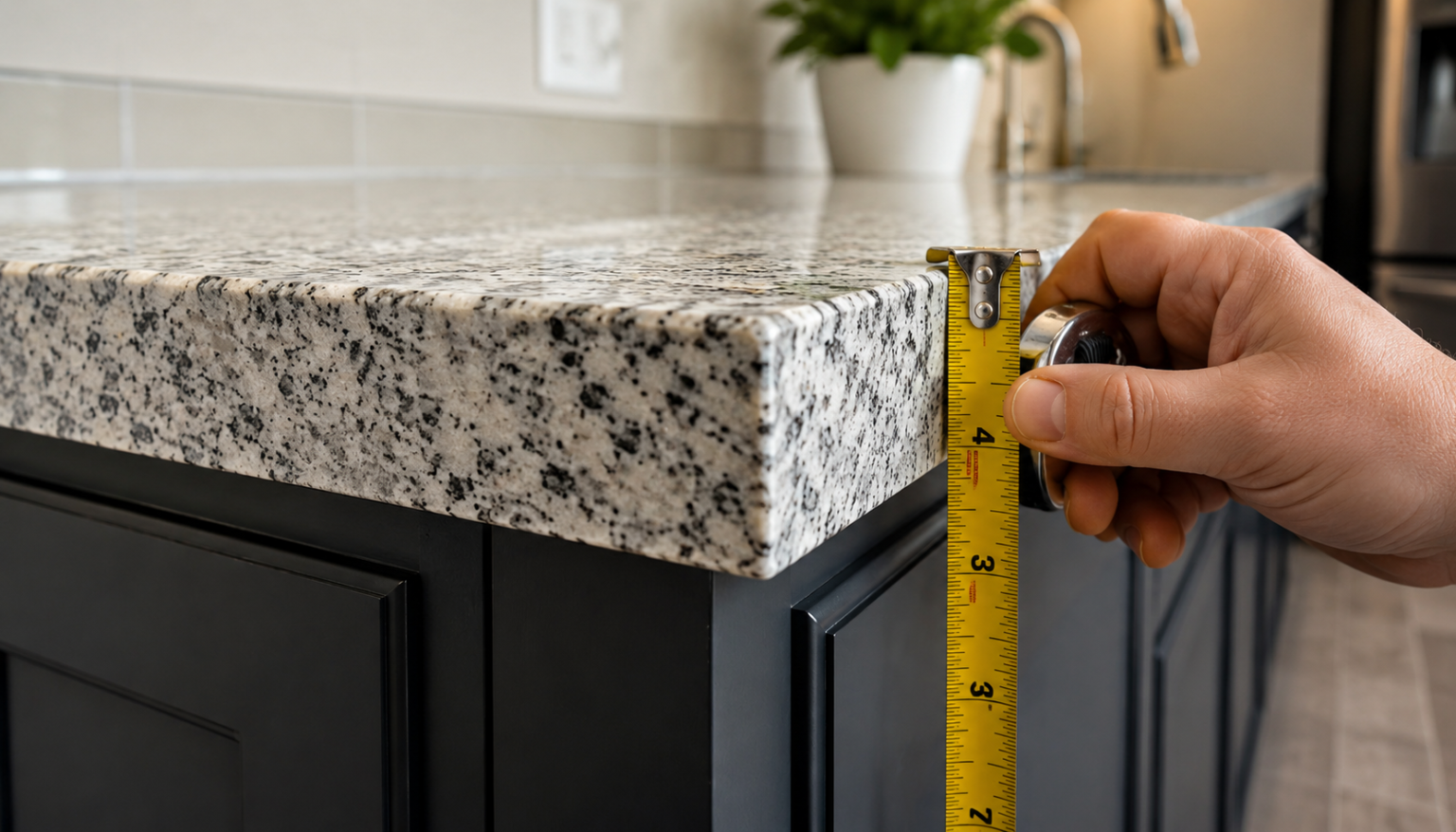
If you’re renovating your kitchen, you’ve probably found yourself asking: how thick is granite kitchen counter material, exactly, and does it even matter? The short answer is that most granite kitchen countertops in the U.S. are either 2 centimeters (about 3/4 inch) or 3 centimeters (about 1 1/4 inches) thick, with 3cm being the standard choice for kitchens today. But the full answer involves weight, cost, cabinet support, edge style, and how you actually use your kitchen — and getting it wrong can mean a countertop that sags, cracks, or costs far more than it needed to.
This guide breaks down every standard thickness, what it costs installed (not just per-slab), how thickness affects sinks and overhangs, and how to avoid the mistakes that trip up first-time buyers.
Standard Granite Countertop Thickness Options
Granite slabs are quarried and cut to a handful of standard thicknesses. Custom thicknesses exist, but nearly every kitchen counter you’ll see falls into one of these four categories.
| Thickness | Metric | Imperial | Typical Use |
|---|---|---|---|
| Thin | 1cm – 1.5cm | ~3/8″ – 5/8″ | Backsplashes, wall cladding, tabletop overlays |
| Standard | 2cm | ~3/4″ | Bathroom vanities, budget kitchens, laminated-edge kitchens |
| Most Popular | 3cm | ~1 1/4″ | Kitchen countertops, islands, high-traffic surfaces |
| Extra-Thick | 4cm+ | ~1 1/2″+ | Statement islands, waterfall edges, luxury kitchens |
2cm Granite: The Budget-Friendly Option
A 2cm slab is roughly 3/4 inch thick. It’s lighter, less expensive per square foot, and easier for two installers to carry and set without heavy equipment. The trade-off is that 2cm granite almost always needs a plywood substrate glued underneath it for structural support, especially around sink cutouts and any overhang past the cabinet edge. Without that backing, a 2cm slab can flex, crack at stress points, or chip along unsupported edges.
Many homeowners choose 2cm and then have the front edge “built up” with a strip of matching granite so the counter looks like a full 3cm or 4cm slab from the front. More on that technique below.
3cm Granite: The Kitchen Standard
A 3cm slab, at roughly 1 1/4 inches, is the thickness most fabricators recommend for kitchens, and it’s what you’ll see in the majority of new installations. It’s rigid enough to span standard 24-inch base cabinets without sagging, strong enough to handle stand mixers, cast iron pans, and daily chopping and prep, and it doesn’t typically require a plywood underlayment. It also holds a wider variety of finished edge profiles cleanly, since there’s more material to shape.
4cm and Thicker: The Statement Choice
Slabs at 4cm (about 1 1/2 inches) or beyond are used deliberately for visual impact — a waterfall-edge island, a bold farmhouse-style counter, or a kitchen where the countertop itself is meant to be a design feature.
They’re heavier, pricier, and usually require reinforced cabinetry, but for the right kitchen they create a look that thinner slabs simply can’t match. True custom slabs beyond 6cm exist but are rare outside of architectural or commercial projects.
How Thick Should Granite Countertops Be for a Kitchen?
For a standard residential kitchen, 3cm is the recommended default. Here’s the practical reasoning:
- Durability: 3cm resists chipping at the front edge and around sink cutouts far better than 2cm, which matters in a surface that takes daily impact from pots, cans, and utensils.
- Support: 3cm typically doesn’t need plywood backing on standard cabinet runs, which simplifies installation and removes a potential long-term failure point (glued substrates can eventually delaminate).
- Overhangs: 3cm can safely overhang a cabinet edge by up to about 10 inches unsupported; beyond that, most fabricators require corbels or steel support brackets regardless of thickness. A 2cm slab needs support starting at a much shorter overhang, often around 6 inches, because it flexes more easily.
- Resale and appraisal perception: Kitchens with visibly thin countertops can read as “budget” to buyers even when the material itself is high quality; 3cm reads as standard-to-premium.
That said, 2cm isn’t wrong — it’s a legitimate choice if your budget is tight, your cabinets are older or lighter-duty, or you’re using a heavily laminated front edge to simulate a thicker look while keeping the slab itself light. The key is making the choice intentionally rather than by default.
Granite Thickness and Cost: What You’ll Actually Pay
Most online guides quote material cost per square foot and stop there, which is misleading because installation, edge work, and support structures change the real number. As a general 2026 U.S. range for mid-grade granite:
- 2cm installed: roughly $45–$75 per square foot, including basic edge profile and standard installation. Add $5–$10/sq ft if plywood backing is required.
- 3cm installed: roughly $55–$90 per square foot. No backing cost, but material and labor run higher due to weight.
- 4cm+ installed: roughly $75–$120+ per square foot, plus potential costs for reinforced cabinetry if your existing base cabinets weren’t built to carry the extra load.
Exotic colors, book-matched slabs, and elaborate edge profiles (ogee, bullnose, waterfall) will push any of these ranges higher. Always ask your fabricator for a written quote that separates material, fabrication, edge treatment, and installation — this is the only way to compare 2cm vs. 3cm apples-to-apples, since a thinner slab with reinforcement can sometimes cost nearly as much as a straightforward 3cm installation.
How Granite Thickness Affects Sinks, Cutouts, and Seams
This is one of the most overlooked practical questions, and it matters more than most buyers realize.
- Sink cutouts: The area around an undermount sink is the weakest point in any slab, because material has been removed right where the counter needs to support weight (dishes, standing water, garbage disposals). On 2cm granite, fabricators almost always add a plywood or steel rail reinforcement strip around the cutout. On 3cm, the extra material itself usually provides enough strength, though large or off-center sink cutouts can still benefit from added support.
- Faucet and cooktop cutouts: Multiple holes drilled close together (soap dispenser, faucet, air-gap) concentrate stress in a small area. Thicker slabs distribute that stress more safely.
- Seams: Granite slabs come in finite sizes (commonly around 9-1/2 by 6-1/2 feet), so larger kitchens need seams. Thicker slabs generally hide seams less noticeably along the top surface because the additional depth allows for a tighter, more precisely aligned joint — but seam placement should still avoid areas near the sink or cooktop where stress and moisture are highest, regardless of thickness.
The “Thick Look” Trick: Getting a 4-Inch Appearance Without the Weight or Cost
You don’t need an actual 4-inch slab to get the dramatic look of one — and in fact, true 4-inch (10cm) granite isn’t practical or common for countertops; it’s typically reserved for monuments and heavy architectural applications. Instead, fabricators use edge-building techniques on standard 2cm or 3cm slabs:
- Mitered edge: Two pieces of granite are cut at matching 45-degree angles and glued together, then polished so the seam is invisible from the front. This doubles the visible edge thickness with minimal added weight to the field of the counter.
- Laminated edge: A second strip of granite is glued flat beneath the front edge, then shaped and polished to blend seamlessly.
- Waterfall edge: Granite continues vertically down the side of an island to the floor, creating a dramatic, continuous look often used with 3cm or 4cm material.
These techniques let you get a bold, substantial visual profile on a budget-conscious slab — a detail all three of the guides we reviewed mention only briefly, if at all, without explaining how to specify it to your fabricator.
How to Decide: A Practical Checklist
Use this checklist before you sign a contract:
- Check your cabinets. Standard 24-inch base cabinets can handle 3cm granite without modification. Older, lightweight, or IKEA-style cabinet boxes may need reinforcement for 3cm or should stick with 2cm.
- Measure your overhangs. Any unsupported overhang beyond about 6–10 inches (depending on thickness) needs corbels or steel brackets — get this in writing from your fabricator, not a verbal estimate.
- Get a full written quote, broken out by material, fabrication, edge profile, backing/reinforcement, and installation — not just a per-square-foot material price.
- Ask what’s under the sink cutout. If you’re going 2cm, confirm in writing that reinforcement will be added around the sink and cooktop cutouts.
- Bring a sample home. Thickness looks different under kitchen lighting than in a showroom; a physical sample against your cabinets and flooring is the only reliable way to judge it.
- Confirm the thickness in the contract. “Thick-look” edge treatments (mitered or laminated) should be spelled out by name so you know exactly what you’re paying for and receiving.
Frequently Asked Questions
What is the standard thickness for granite kitchen countertops? Three centimeters (about 1 1/4 inches) is the current industry standard for kitchen countertops in the U.S., though 2cm remains common in budget installations, especially with a laminated or mitered front edge.
Is thicker granite always better? Not necessarily. Thicker granite is more durable and typically needs less reinforcement, but it also costs more, weighs more, and can be overkill for lighter-use areas like a bathroom vanity or a small kitchenette. Match the thickness to how the space is actually used.
How much heavier is 3cm granite than 2cm? 3cm granite weighs roughly 18–19 pounds per square foot, compared to roughly 12–13 pounds per square foot for 2cm. For a typical 30-square-foot kitchen run, that’s a difference of about 150–200 pounds, which matters for cabinet load ratings and for how many installers/equipment are needed on install day.
Can I mix 2cm and 3cm granite in the same kitchen? Yes, though it’s uncommon. Some homeowners use 3cm for a statement island and 2cm with a built-up edge for perimeter counters to control cost. If you do this, make sure the visible edge thickness is matched so the kitchen looks intentional rather than mismatched.
Does granite thickness affect how it’s sealed or maintained? No. Sealing frequency and cleaning routine depend on the granite’s porosity, not its thickness. A thicker slab is not inherently more stain-resistant than a thinner one of the same stone.
Will thin granite crack more easily? Thin slabs (1cm–2cm) are more prone to cracking under point-load stress, particularly at unsupported overhangs or around cutouts, if they aren’t properly reinforced. Properly installed and backed 2cm granite, used within reasonable overhang limits, is a durable and long-lasting kitchen surface.
Conclusion
For most kitchens, 3cm (about 1 1/4 inches) is the thickness to plan around — it’s strong enough to go without extra reinforcement, handles daily kitchen wear well, and supports a wide range of edge styles. A 2cm slab can still be a smart, budget-friendly choice as long as it’s properly backed with plywood or steel support, especially around sink cutouts and overhangs.
Before you commit, walk through the checklist above with your fabricator, get every cost and support detail in writing, and bring home a physical sample to see how it looks against your actual cabinets and lighting.
Ready to move forward? Reach out to a local granite fabricator for a written, itemized quote comparing 2cm and 3cm options for your specific kitchen layout — it’s the single best way to make sure you’re paying for exactly the countertop you want.
Related Articles
Why Does My Bathroom Sink Smell Like Rotten Eggs? (Causes & Easy Fixes)
Should Curtains Touch the Floor? The Complete Guide to Curtain Length