


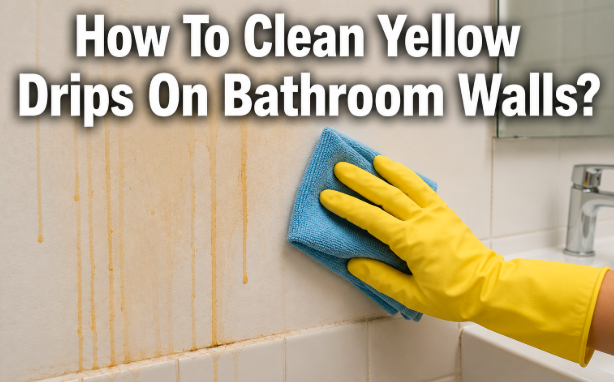
Yellow drips on bathroom walls almost always come from one of four things: paint that hasn’t fully cured yet, mold or mildew feeding on steam, hard water mineral buildup, or old nicotine residue. In most cases, a damp cloth and a little mild dish soap clears them in a few minutes. The part that trips people up is matching the method to the real cause, since scrubbing mold with soap alone barely touches it, and hitting fresh paint with bleach can make the marks worse.
It’s a strange thing to notice, usually after a hot shower when the light hits the wall just right. A thin, yellowish line has run from somewhere near the ceiling down toward the tile, and it wasn’t there last week. It looks worse than it is in nearly every case, but cleaning it the wrong way can leave a bigger mess than the one you started with.
Here’s how to tell the causes apart, the exact steps for cleaning each one, and what to do if the drips keep showing up no matter how often you wipe them away.
What’s causing the yellow drips on your wall?
Check three things before you grab a cleaner: how the stain feels, whether it has a smell, and how old the paint is.
If your bathroom was painted in the last few weeks or months, glossy or tan drips that run from the top of the wall down are almost certainly surfactant leaching. This happens when water-soluble ingredients in latex paint rise to the surface before the paint fully cures, usually because steam or condensation hit the wall too soon. It’s cosmetic, not a sign of a bigger problem, and it fades as the paint finishes curing.
If the paint is older, the stain is fuzzy or slightly raised, and there’s a musty smell, you’re looking at mold or mildew. These grow wherever moisture sits on a surface for too long, and a bathroom with poor airflow is exactly the kind of place they thrive.
Crusty, white-tinged yellow marks that build up slowly, especially around a showerhead or where water runs down tile grout onto the wall, point to hard water. Minerals like calcium and magnesium are in nearly every water supply, and they leave a chalky residue behind as water evaporates.
A yellow-brown film with no odor and no bumpy texture, especially in an older home where someone used to smoke indoors, is usually nicotine. It clings to walls and ceilings alike and tends to show faint outlines where picture frames or shelves once blocked it.
One quick test helps when two causes look alike: dab a small amount of the residue with a damp white cloth. Surfactant leaching and mineral deposits lift cleanly and leave the cloth looking slightly cloudy or chalky. Mold smears rather than lifts, and the cloth often picks up a faint greenish or black tinge along with the yellow. Nicotine leaves a brownish-yellow film on the cloth with a faint smoky smell even if the wall itself doesn’t smell strongly.
| Cause | Texture | Smell | When it shows up |
| Surfactant leaching | Glossy, tacky, or oily | None | Weeks after a fresh coat of latex paint |
| Mold or mildew | Fuzzy or slightly raised | Musty | Older paint, poor ventilation |
| Hard water minerals | Crusty, chalky | None | Near showerheads, faucets, tile lines |
| Nicotine residue | Smooth film | Faint smoke smell | Older homes, long-term smokers |
How to clean surfactant leaching
Surfactant leaching is the most common reason for yellow drips on newly painted bathroom walls, and it’s also the easiest to fix. It shows up because latex paint contains water-soluble ingredients that help it go on smoothly, and if moisture reaches the wall before the paint finishes curing, those ingredients rise to the surface and dry into a visible streak.
The Sherwin-Williams guide to fixing surfactant leaching confirms this is a harmless byproduct of the paint curing process, not a defect in the wall or a sign the job was done poorly.
You only need a few things for this one: a soft sponge or microfiber cloth, warm water, and a mild dish soap for anything water alone won’t shift.
- Wet a soft sponge or microfiber cloth with warm water and wipe the affected area, working from the bottom up so you don’t create new drip marks.
- If the residue doesn’t lift with water alone, add a few drops of mild dish soap to the water and wipe again, rinsing the cloth often.
- Dry the wall with a clean towel and run the exhaust fan for at least 20 minutes.
- Expect to repeat this two or three times over the following weeks as more surfactant rises to the surface and washes away.
| Don’t scrub hard, use an abrasive pad, or repaint over the marks. Fresh paint is soft while curing, usually for about 30 days, and sealing the residue under a new coat traps it and often makes it worse. |
How to clean mold and mildew stains
Mold needs a slightly stronger approach than a plain water wipe, since it grows into the surface rather than just sitting on top of it.
- Turn on the exhaust fan and open a window if you have one, since you’ll want good airflow while you work.
- Mix one part household bleach with three parts water, or use a store-bought mold and mildew cleaner labeled safe for painted walls.
- Apply the solution with a sponge and let it sit for five to ten minutes so it can reach mold growing below the surface.
- Scrub gently in a circular motion, then rinse with clean water and dry the wall completely with a towel.
- If you’d rather skip bleach, white vinegar works on light mold and is safer around fixtures, though it takes more repeat applications.
The Environmental Protection Agency’s mold cleanup guidance notes that a moldy area under about 10 square feet is usually safe to handle yourself with detergent and water, while larger or recurring patches may need a closer look at what’s feeding the moisture.
Anything bigger than roughly a 3 foot by 3 foot patch, or mold caused by a plumbing leak rather than everyday humidity, is worth handing to a professional rather than treating as a routine wipe-down.
Wear gloves and, if you’re sensitive to mold or have asthma, a basic dust mask while you scrub. Never mix bleach with ammonia or other cleaners, since the combination produces dangerous fumes. If the mold returns within a few weeks in the same spot, the underlying moisture problem hasn’t been fixed yet, not the cleaning method.
How to clean hard water mineral stains?
Mineral deposits respond best to an acid, and the one already in your kitchen works fine.
- Fill a spray bottle with equal parts white vinegar and water.
- Spray the stained area and let it sit for 10 to 15 minutes to break down the mineral buildup.
- Scrub with a soft brush or non-scratch sponge, focusing on any crusty buildup near the showerhead or faucet.
- Rinse thoroughly with clean water so the vinegar smell doesn’t linger, and dry with a towel.
- For stains that don’t budge, swap the spray for a paste of baking soda and a little water, applied directly to the spot and left for 15 minutes before scrubbing.
Avoid vinegar on natural stone tile or grout, since the acid can etch the surface over time. On painted drywall, a diluted mix and a gentle hand are enough; there’s no need for a stronger acid or a commercial descaler.
If mineral stains show up again within a week or two of cleaning, the water itself is probably the root cause rather than anything on the wall. A softer approach that treats the water before it hits the wall, rather than scrubbing the result, tends to be the better long-term fix.
How to clean nicotine stains?
Nicotine residue is oily and needs a degreaser rather than a simple soap-and-water wipe.
- Mix a solution of warm water and trisodium phosphate (TSP), following the ratio on the product label, or use a dedicated degreasing wall cleaner.
- Wearing gloves, wipe the wall with a sponge soaked in the solution, working in small sections.
- Rinse each section with clean water before it dries, since TSP can leave a residue of its own if left to sit.
- Repeat on heavily stained areas, and expect a slightly yellow tint to remain on older paint even after cleaning, since nicotine can penetrate the paint film itself.
- If the stain won’t lift after two or three attempts, a stain-blocking primer followed by a fresh coat of paint is the more permanent fix.
Why do the drips keep coming back?
If you’ve cleaned the wall and the same drips reappear within days, the moisture behind them hasn’t gone away. A bathroom fan that’s too small for the room, a shower door left open after use, or a habit of skipping the fan on quick showers all keep humidity high enough to reintroduce the problem, whether it’s fresh surfactant, new mold, or more mineral buildup.
For surfactant leaching specifically, repainting over active staining almost guarantees it returns, since the new coat introduces another layer of uncured paint into the same damp environment. The better fix is to let the current coat finish curing, which can take up to a month, and improve ventilation in the meantime. If leaching is still showing up after that window, a bathroom-rated paint formulated to resist moisture, applied over a properly cleaned and dried surface, tends to solve it for good.
Darker paint colors are more prone to visible surfactant leaching than lighter ones, since they carry more of the additives that cause it, so a repeat problem after repainting a dark accent wall isn’t unusual and doesn’t point to anything else being wrong.
How to stop yellow drips from coming back?
A few habits make a bigger difference than any single cleaning product.
- Run the exhaust fan during every shower and for 20 to 30 minutes after, or open a window if the fan alone doesn’t clear the steam.
- Squeegee the walls and shower door after each use. It takes under a minute and removes most of the moisture before it has a chance to sit.
- Wipe down the walls with a dry towel once a week, even if you don’t see visible stains yet.
- Check that the bathroom door has enough clearance underneath, or stays open after showers, so air can actually circulate.
- If your home has hard water, a shower filter or whole-house softener cuts down on the mineral buildup that causes chalky stains in the first place.
- Repaint bathroom walls with a paint rated for high-humidity rooms rather than standard wall paint, especially if the room has a history of staining.
- Keep a small dehumidifier in the bathroom if the room has no window and the exhaust fan struggles to keep up, particularly in winter when cooler walls make condensation worse.
None of these need to happen all at once. Starting with the fan and the squeegee, the two cheapest habits on the list, clears up most everyday cases within a couple of weeks.
Conclusion
Yellow drips on bathroom walls are usually one of four things: curing paint, mold, hard water minerals, or nicotine, and each one has a cleaning method that actually works on it. Match the fix to the cause, dry the wall fully afterward, and keep the room ventilated. Do that consistently and the drips stop coming back.
Frequently asked questions
Are yellow drips on bathroom walls dangerous?
Surfactant leaching and mineral deposits are harmless and purely cosmetic. Mold can affect indoor air quality and is worth cleaning promptly, especially if anyone in the home has allergies or asthma.
How long does surfactant leaching last?
It usually clears up within 30 days as the paint finishes curing, though it can take a few rounds of wiping. If it’s still appearing after a month of good ventilation, the paint may need a proper wash and, in some cases, a repaint with a moisture-resistant formula.
Can I use bleach on painted bathroom walls?
Yes, a diluted bleach solution (one part bleach to three parts water) is safe on most painted walls for mold and mildew, but always rinse well afterward and never mix bleach with ammonia-based cleaners.
Why do the drips only appear after a hot shower?
Heat and steam are what activate the underlying cause, whether that’s pulling surfactants out of curing paint, feeding mold spores, or evaporating mineral-laden water and leaving deposits behind. Better ventilation during and after showers reduces all three.
Is it mold or just paint residue?
Mold is fuzzy or slightly raised and smells musty. Surfactant leaching and mineral deposits are flat, don’t smell, and wipe away more easily. When in doubt, dab it with water: if it thins out cleanly, it’s likely residue; if it smears and stays discolored, treat it as mold.
Related Articles
How to Overlap Metal Roofing Lengthwise for a Leak-Free Roof?
How to Get Super Glue Off a Wood Floor? Without Ruining the Finish
Why Are Your Hardwood Floors Suddenly Slippery?
Small Black Bugs in Bathroom: What They Are and How to Get Rid of Them