


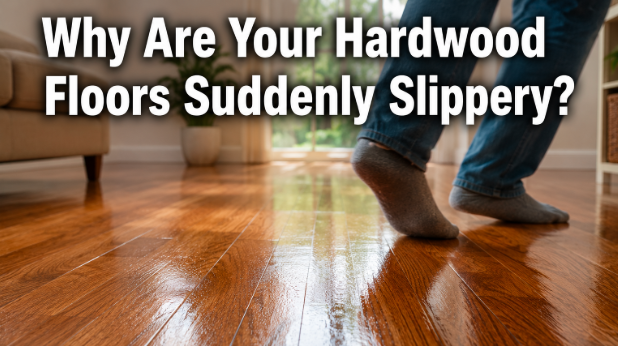
If your wood floor has gone from normal to slick in a day or two, something has been added to the surface. It’s rarely the wood changing on its own. The usual suspects are a cleaning product residue, an overspray from another product, a shift in humidity, construction dust, or a spill you haven’t noticed yet. Find the recent change, and the fix is usually simple.
What actually makes a wood floor slippery
A finished wood floor relies on friction between its top coat and your feet, socks, or shoes. That top coat, usually polyurethane, wax, or oil, is designed to have a certain amount of grip built in. Anything that sits on top of it, even a very thin film, changes that grip instantly.
Water, oil, wax, and fine dust all work the same way. They fill in the tiny texture of the finish and let your foot glide instead of catching. That’s why a change can feel dramatic even when you can’t see anything different on the floor. A film thin enough to be invisible is still thick enough to remove your traction.
Why it happened suddenly instead of gradually
Wear from years of foot traffic makes a floor slippery slowly, over months, and it’s usually most noticeable in a worn path near a doorway or hallway. A sudden change points somewhere else: a specific event in the last few days.
Think back to anything that changed right before you noticed it: a new cleaning product, a different mop, painting or roof work, a run of humid weather, a new rug, or a product used elsewhere in the house that could have drifted through the air.
If you can name the day it started, you can usually name the cause. Sudden slipperiness has a trigger; it doesn’t appear from nowhere.
A cleaning product or residue is sitting on the finish
This is the single most common cause of a sudden change. Multi-surface cleaners, oil soaps, and anything described as a “shine” or “polish” product often leave behind a thin waxy or soapy film. One mopping with the wrong product is sometimes all it takes, especially on a factory-finished floor that was never meant to be waxed at all.
A floor coated this way often looks a little duller or hazier than usual, and it can feel slightly tacky before it feels slick. If you or a cleaning service recently switched products, mopped more heavily than usual, or used anything with the word wax, oil soap, or polish on the label, this is the likely cause.
Something drifted onto the floor
Overspray travels further than most people expect. Furniture polish sprayed on a nearby table, a silicone-based spray, hairspray used down the hall, or even a heavy application of fabric softener spray can settle as an almost invisible film on a hard floor several feet away. It tends to affect one area more than the rest of the room, which is a useful clue.
If the slippery patch lines up with where you spray a product, dust furniture, or use an aerosol, this is worth testing first since it’s the easiest to confirm and the easiest to fix.
The air in the house changed
Wood absorbs and releases moisture with the surrounding air, and a run of humid or rainy days can leave a fine layer of condensation on the surface, particularly in a bathroom, kitchen, or a room with a door to the outside. Central heating and cooling changes can do the same thing in reverse, drawing moisture out and changing how the finish feels underfoot.
This tends to affect the whole floor evenly rather than one patch, and it often eases up once the weather or indoor humidity settles back down.
Dust from renovation or duct work
Roof work, drywall repair, insulation disturbance, or even running the furnace for the first time after months off can send a fine layer of dust through the house. Some of this dust carries a slight oily or waxy component, especially insulation fibers or old attic dust, and it settles on hard floors as an almost invisible coating that plain sweeping doesn’t fully remove.
If the slipperiness started around the same time as any work on the house, even work that seems unrelated to the floor itself, this is worth ruling out before anything else.
A spill you haven’t spotted yet
Cooking oil, lotion, hair product, a leaked pet treat, or a spilled drink that dried clear can all leave a slick patch that’s genuinely hard to see, especially under normal lighting. Get down at floor level and look across the surface at a low angle, the way you’d check a car windshield for streaks. A slick patch usually shows up as a faint sheen or a slightly different reflection than the surrounding floor.
A new rug, mat, or rug pad
Some rug backings and cheaper rubber or PVC rug pads break down over time and leave a residue on the floor underneath and around the edges, especially in a warm room or under direct sun. If the slippery area is near where a rug or mat sits, or where one used to sit, check the backing and the floor underneath it for a sticky or filmy patch.
What’s on your feet
Sometimes the floor hasn’t changed at all. New socks, slippers with a smooth sole, or fabric softener residue on laundry can all reduce your own grip on a completely normal floor. If the slipperiness follows you (it happens in socks but not barefoot, or with one pair of slippers but not another) the floor is probably fine.
How to figure out which cause is yours
Work through this quickly rather than guessing:
- Touch it. Rub a clean, dry hand across the slippery spot. Tacky or waxy points to product residue; slick and smooth with no texture points to moisture, oil, or dust.
- Compare rooms. If only one room or one patch is affected, think about what’s different there: a rug, a vent, recent spraying, or nearby renovation work.
- Check the timeline. Line up the day you noticed it against anything that changed in the days before: cleaning, weather, footwear, construction, or a new rug.
- Test barefoot. If it’s slippery barefoot too, the floor has residue or moisture on it. If it’s only slippery in certain footwear, the floor itself is fine.
How to fix it safely
Once you have a likely cause, match the fix to it rather than reaching for the strongest cleaner in the house.
For product residue or wax buildup, switch to a cleaner made specifically for your floor’s finish and avoid anything labeled multi-surface, shine, or polish. Damp mop lightly with a microfiber pad rather than soaking the floor, and go over the area a second time with plain water to lift any leftover residue. Heavier wax buildup sometimes needs a dedicated wax remover or, in stubborn cases, a light pass with odorless mineral spirits on a small test area first.
For overspray or a light film, a damp microfiber cloth and a small amount of a pH-neutral wood floor cleaner usually clears it in one pass. For moisture or humidity, simply let the room air out and dry; running a fan or dehumidifier speeds this up. For dust after renovation work, a thorough vacuum with a hard-floor setting followed by a light, correctly diluted cleaning pass usually resolves it.
The National Wood Flooring Association recommends sticking to a cleaner formulated for your specific finish, avoiding wax and oil treatments on factory-finished floors, and skipping wet mops or steam mops, since excess moisture can cause its own problems on top of whatever caused the slipperiness in the first place.
When to call a professional
If the slick feeling doesn’t lift after a proper cleaning, or the floor looks cloudy, gray, or worn through to bare wood in patches, the finish itself may be compromised rather than just coated with something removable.
A flooring professional can confirm whether the floor needs a maintenance coat, a full sand and refinish, or just a deeper strip-and-clean than a household routine can manage.
Falls on slippery flooring are a real hazard rather than a minor inconvenience; the Consumer Product Safety Commission tracks flooring-related falls as one of the more common causes of home injury, so it’s worth treating a genuinely slick floor as something to fix promptly rather than work around.
Keeping it from happening again
Once the current cause is cleared, a few habits keep it from coming back. Stick to one cleaner made for your floor’s exact finish and skip anything else, even if a bottle promises extra shine.
Spray products, whether furniture polish, hairspray, or aerosol cleaners, away from the room or with the floor covered. Wipe up spills the moment you see them instead of letting them dry into an invisible film.
And after any renovation, painting, or duct work, give the floor a proper vacuum and damp-clean pass before assuming it’s back to normal, since dust from that kind of work settles for days after the job looks finished.
Conclusion
A hardwood floor that turns slippery overnight is telling you something changed on the surface, not that the wood itself failed. Trace it back to a recent cleaning product, overspray, humidity swing, renovation dust, spill, or rug, then clean with the right product for your finish rather than a stronger one. A floor that’s back to its normal grip after that is a floor that’s actually fixed, not just masked.
Frequently asked questions
Why did my hardwood floor become slippery after I mopped it?
The cleaner probably left a thin residue on the finish. This is common with multi-surface cleaners, oil soaps, or anything labeled as a shine or polish product. Switch to a cleaner made for your floor’s specific finish and mop lightly.
Can humidity really make a wood floor slippery?
Yes. A run of humid or rainy weather can leave a fine layer of moisture on the surface, especially in kitchens and bathrooms. It usually affects the whole floor evenly and settles once the humidity drops.
Is vinegar safe for cleaning a slippery hardwood floor?
Vinegar is acidic and can dull or damage some finishes over time, so it’s not the first choice. A pH-neutral cleaner made for your floor’s finish removes residue without that risk.
Why is only one part of my wood floor slippery?
A localized slick patch usually points to something specific in that area: overspray from a nearby product, a rug or rug pad that’s breaking down, or a spill that dried without leaving a visible mark.
How do I know if it’s the floor or my socks?
Test barefoot in the same spot. If it’s still slippery, the floor has residue, moisture, or dust on it. If it’s only slippery in socks or certain slippers, the floor itself is fine.
Related Articles
Small Black Bugs in Bathroom: What They Are and How to Get Rid of Them
How to Get Super Glue Off a Wood Floor? Without Ruining the Finish
How to Overlap Metal Roofing Lengthwise for a Leak-Free Roof?