


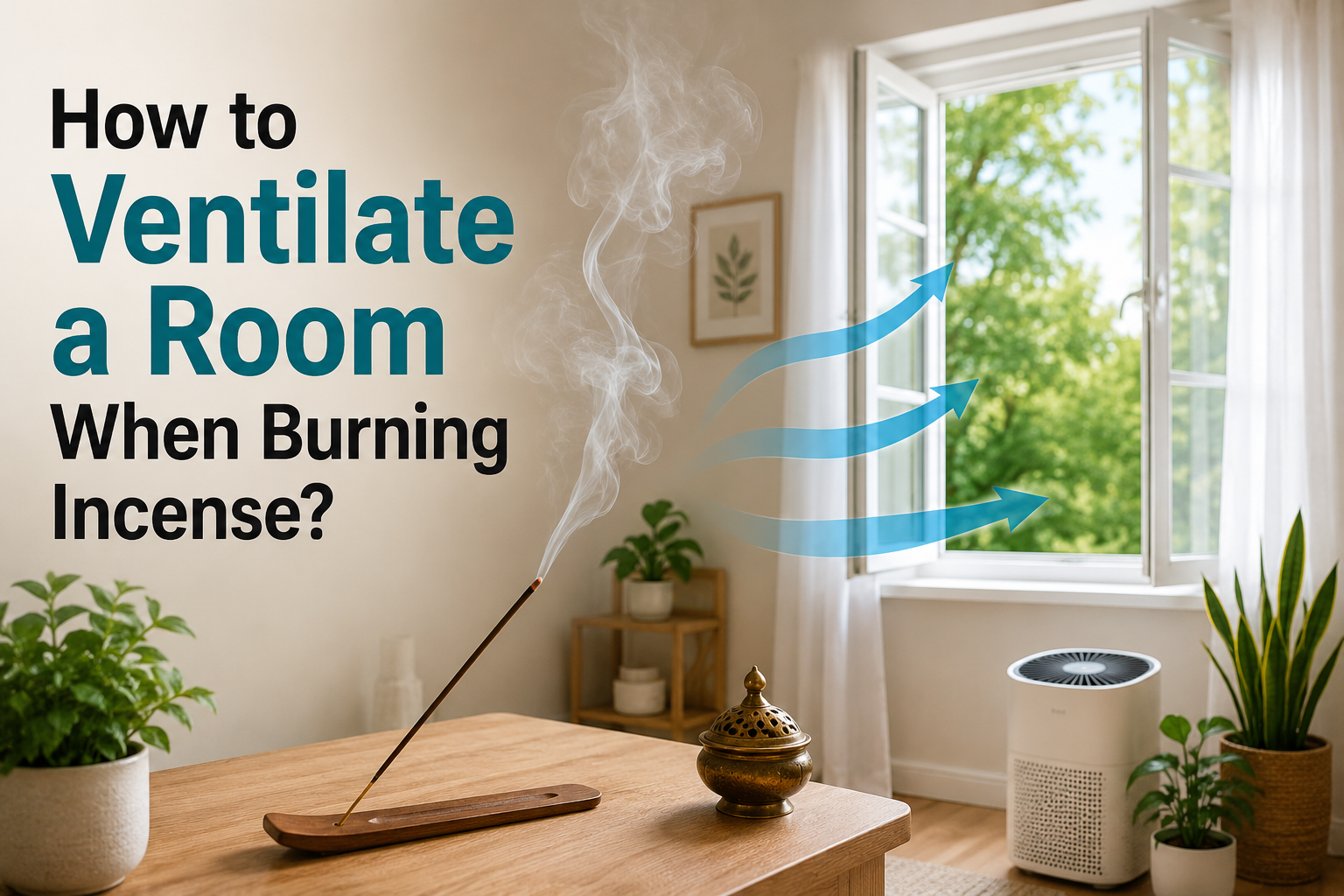
To ventilate a room when burning incense, create airflow that moves through the room rather than just letting smoke drift toward a single window. Open two openings on different sides, such as a window and a door, so fresh air comes in one side and pushes the smoky air out the other. Add a fan aimed toward an exit to keep the air moving, and run a HEPA air purifier during the session and for a while after. That combination clears smoke far better than cracking one window and hoping.
Incense smells wonderful, but burning it releases fine particles and gases into the air you breathe. Good ventilation is what lets you enjoy the ritual while keeping the room’s air healthy. Here is how to set it up properly, plus what to do in small or windowless spaces.
| The key idea: ventilation is about airflow, not just an opening. One cracked window lets a little smoke escape slowly. Two openings on different sides let fresh air sweep the smoke out, which is much more effective. |
Why incense smoke needs real airflow
When an incense stick burns, combustion releases three things: the fragrance you want, visible smoke, and fine particulate matter you cannot see. That particulate matter, especially the tiny PM2.5 particles, is the part worth managing, because it can linger in the air and, in high enough concentrations, irritate the lungs. Incense sits alongside candles, cooking, and fireplaces on the list of common indoor sources of these particles.
In a sealed room, those particles build up and stay suspended for a long time. Ventilation dilutes them with fresh outdoor air and carries them out. This is not just folk wisdom: the US EPA advises ensuring proper ventilation whenever you burn candles or incense indoors, and studies of indoor air find that opening windows and internal doors together noticeably lowers the spike in fine particles compared with keeping a space closed. The takeaway is simple: the more you can move clean air through the room, the less smoke you and others actually breathe.
How to set up cross-ventilation, step by step?
Cross-ventilation just means air enters at one point and leaves at another, sweeping the room on the way. It is the single most effective thing you can do. Set it up like this:
- Open two points on different sides. A window on one wall and a door or second window on another creates a path for air to travel across the room. Two openings beat one every time, because a lone window mostly lets air drift, not flow.
- Let the incoming side be your fresh air. Position yourself and the incense so clean air comes in behind you and the smoke travels away toward the far opening, rather than back across your face.
- Crack, do not fling. You want gentle, steady circulation, not a gale. Even a 2 to 4 inch gap at each opening moves a surprising amount of air, and a soft flow keeps ash from scattering.
- Close doors to rooms you want to protect. If you would rather smoke not drift into a bedroom or closet, keep those doors shut so your airflow path leads to an outside opening instead.
- Keep it going after you finish. Smoke and particles do not vanish the moment the stick burns out. Leave your ventilation running until the visible smoke is gone and the air smells clear.
If your room only has one window, you can still create flow: open that window and the room door, and use a fan to bridge the two, which we will get to below.
Where to place the incense? (and where not to)
Placement affects both safety and how well the smoke clears. A few rules keep things clean.
- Use a stable, heat-safe holder. A ceramic or stone ash catcher collects falling ash, positions the stick so smoke rises cleanly, and prevents tipping. A proper holder is not optional.
- Choose a mid-height, uncluttered surface. A coffee table, sideboard, or shelf lets the smoke rise freely. Keep the burning tip well away from curtains, paper, books, bedding, and anything else that could catch an ember.
- Do not put the incense directly in the draft. This surprises people. Placing it right under a vent, fan, or open window pushes the smoke sideways and makes the stick burn unevenly and too fast. Let it sit in still air near, but not inside, the airflow path, so the smoke rises and then gets carried out.
- Never leave it unattended. It is an open ember. Stay in the room, and make sure it is fully out before you leave or sleep.
Add a fan and an air purifier
Open windows do the heavy lifting, but two tools make ventilation dramatically better, especially when the weather or your building limits how much you can open up.
A fan keeps air moving on demand. A ceiling fan on low, a portable fan angled toward an open window or door, or a bathroom or kitchen exhaust fan will all pull smoke out and prevent stagnant pockets. Exhaust fans are purpose-built to remove odors and airborne particles, so use them if the room has one. Just aim any fan so it draws smoke toward an exit, not straight at the incense.
A HEPA air purifier captures the fine particles that ventilation alone may leave behind. Look for one with both a HEPA filter, which traps the vast majority of PM2.5, and an activated-carbon filter, which helps with odors and some gases. Size it to your room, and run it during the session and for at least 30 to 60 minutes afterward to clear lingering particles.
Here is how the main tools compare, so you can mix the ones that fit your space.
| Tool | What it does | Best for |
| Two open windows/doors | Sweeps smoke out with fresh air | The core method, any room with openings |
| Fan (portable or ceiling) | Keeps air moving toward an exit | Boosting weak natural airflow |
| Exhaust fan | Pulls particles and odor outside | Kitchens and bathrooms |
| HEPA + carbon purifier | Filters fine particles and odor | Small rooms, ongoing air quality |
Small rooms and no-window spaces
Tight or windowless spaces concentrate smoke faster, so they need a bit more care. A few adjustments help:
- Burn in a larger, open room first. If you have the choice, light incense in a bigger space where smoke disperses, rather than a cramped closed one.
- Lean on a purifier and a fan. With no window, a HEPA purifier plus an exhaust fan or a fan pointed toward an open door becomes your main ventilation. Keep the door to a ventilated area open.
- Pick low-smoke incense. Resin-free or low-smoke sticks and cleaner, lighter blends put out fewer particles, which matters most in small rooms. Higher-quality natural incense also tends to produce less irritating smoke than cheap synthetic sticks.
- Keep sessions short. A 15 to 30 minute session gives you plenty of fragrance without letting particles pile up. Light it a little before you want the scent, then let the room clear.
When to skip incense or air out longer?
Ventilation reduces exposure, but it cannot make combustion smoke completely harmless. Some situations call for extra caution or a different choice.
If anyone in the home has asthma, allergies, or other respiratory sensitivities, it is best to avoid burning incense around them, or to check with their doctor first, since the particles and gases can trigger symptoms. The same goes for spaces shared with young children or anyone especially vulnerable. If you or someone in the room starts coughing, tearing up, or feeling short of breath, put the incense out and air the space out right away.
On days when incense is not the right call, flameless alternatives like an essential oil diffuser or a room spray give you scent without combustion smoke, though even those can bother sensitive people and are best used lightly with some ventilation. And any time you leave a room where incense was burning, let your ventilation or purifier keep running for another half hour or so to finish clearing the air.
Conclusion
Ventilating for incense comes down to moving air through the room, not just opening a single window. Set up cross-ventilation with two openings on different sides, add a fan aimed toward an exit, and run a HEPA and carbon purifier during and after your session.
Place the incense on a heat-safe holder in still air near the airflow, keep sessions short, and skip it around anyone with breathing sensitivities. Do that, and you get the calm and the fragrance while keeping the air you breathe clean.
Frequently asked questions
Is it enough to just crack one window?
It helps, but it is not the most effective option. One window lets smoke drift out slowly. Opening a second point on another side, so air flows across the room, clears smoke much faster. Add a fan if natural airflow is weak.
Can I burn incense in a room with no windows?
Yes, but ventilate carefully. Open the door to a ventilated area, run an exhaust fan or a fan pointed toward the door, and use a HEPA air purifier. Choose low-smoke incense and keep sessions short, since smoke concentrates fast in enclosed spaces.
Does an air purifier remove incense smoke?
A HEPA purifier captures most of the fine particles, and an activated-carbon filter helps with odor and some gases. It works best alongside open-window ventilation, and should run during the session and for 30 to 60 minutes after.
How long should I burn incense indoors?
Keep sessions fairly short, around 15 to 30 minutes, then let the room air out before relighting. Light it a bit before you want the scent, and avoid burning several sticks back to back in a closed room.
Is burning incense safe for people with asthma?
It can trigger symptoms. Incense produces fine particles and gases that may worsen asthma or allergies in sensitive people. If someone in the home has a respiratory condition, it is best to avoid indoor burning or check with their doctor first.
Related Articles
What Is the Average Height of a Door?
How to Cover Up Popcorn Ceiling: 6 Easy Methods for a Modern Look
Is Ceiling Paint Different From Wall Paint? Complete Guide
How to Put Up Ceiling Tiles: A Step-by-Step Guide
How Much Does Epoxy Flooring Cost? Complete 2026 Pricing Guide