


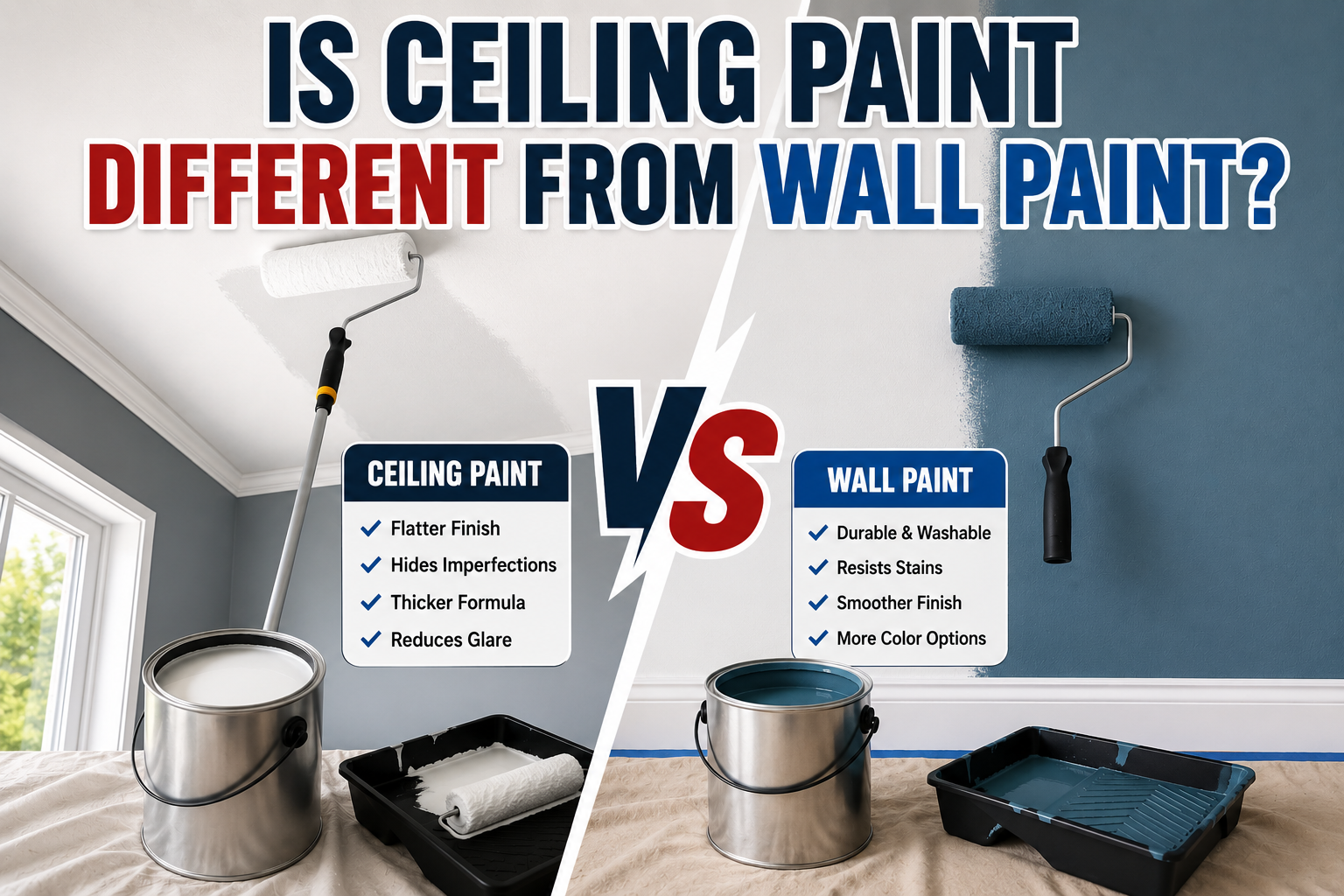
If you have ever stood in the paint aisle staring at two cans that look almost identical, you have probably asked yourself: is ceiling paint different from wall paint? It is a fair question, because at first glance both products seem to do the same job — they cover a surface and give it color. However, once you look closer, you will find that ceiling paint and wall paint are formulated with very different goals in mind.
This guide breaks down everything you need to know about the differences between these two products, when you can use one in place of the other, and how to choose the right paint for your next home improvement project. By the end, you will have a clear, practical answer to the question “is ceiling paint different from wall paint,” along with the confidence to make the right purchase for your walls and ceilings alike.
What Is Ceiling Paint?
Ceiling paint is a specialty product designed specifically for overhead surfaces. Because ceilings are viewed from a unique angle and under different lighting conditions than walls, manufacturers formulate ceiling paint to solve problems that are unique to that surface. It is usually thicker than standard wall paint, which helps prevent drips and splatters from falling onto your floor, furniture, or face while you are rolling it on above your head.
Most ceiling paints come in a flat or matte finish. This is intentional, since a flat finish does not reflect light the way glossier paints do, which helps hide small imperfections like uneven drywall seams, nail pops, or patch marks that are common on ceilings. Many ceiling paints are also sold in a light tint, such as pale pink or blue, that gradually dries down to a bright white. This color-changing feature makes it easy to see which areas you have already covered, so you do not miss a spot.
What Is Wall Paint?
Wall paint, on the other hand, is designed for vertical surfaces that are seen up close and are often touched, cleaned, or bumped into on a regular basis. Because of this, wall paint is available in a much wider range of finishes, from flat and eggshell to satin, semi-gloss, and high gloss.
The finish you choose for a wall depends heavily on the room. A satin or eggshell finish is popular in living rooms and bedrooms because it offers a soft look while still being easy to wipe down. Semi-gloss or gloss finishes are common in kitchens, bathrooms, and trim work because they resist moisture and stains better than flat finishes.
Wall paint also tends to have a thinner consistency than ceiling paint, since it does not need to resist gravity in the same way, and it is generally formulated to allow for smoother, more controlled brush and roller strokes on a vertical plane.
Key Differences Between Ceiling Paint and Wall Paint
Now that you understand the basic purpose of each product, let’s go deeper into the specific differences that answer the question, is ceiling paint different from wall paint, in more technical terms.
Sheen Level
Sheen refers to how much light a paint reflects once it dries. Ceiling paint is almost always flat or matte because a shiny ceiling would reflect light unevenly and draw attention to every bump, seam, or imperfection above your head. Wall paint offers a wider spectrum of sheen options because walls are meant to be seen up close, touched, and sometimes cleaned, so a bit of shine can actually be desirable depending on the room.
Viscosity and Thickness
One of the most noticeable differences between the two products is how thick they are straight out of the can. Ceiling paint is formulated to be thicker so that it clings to the roller and the surface rather than dripping down. Wall paint is thinner, which allows for easier spreading and blending on vertical surfaces without leaving heavy roller marks.
Coverage and Hiding Power
Ceiling paint is often designed to offer excellent hiding power in as few coats as possible, since repainting a ceiling is more physically demanding than repainting a wall. Many ceiling paints are marketed as one-coat solutions that can cover stains, patches, and old paint colors effectively. Wall paint can also offer strong coverage, but the emphasis is usually on color accuracy and finish quality rather than sheer hiding power alone.
Color-Changing (Tinted) Formulas
As mentioned earlier, many ceiling paints use a temporary tint that fades to white as the paint dries. This is a feature you will rarely find in standard wall paint, since walls are usually painted in a visible color from the start and do not need this kind of visual guide.
Application Behavior
Because you are usually painting a ceiling while looking upward, often from a ladder, ceiling paint is engineered to minimize splatter. This reduces the mess that falls back down onto you, your furniture, and your floors. Wall paint does not need this same splatter-resistant formulation since it is applied at eye level or below, where gravity works in your favor rather than against you.
Light Reflection and “Flashing”
Flashing happens when different areas of a painted surface reflect light unevenly, creating a blotchy appearance. Ceilings are especially prone to this because of how light from windows, lamps, and fixtures hits them at an angle. Ceiling paint’s flat finish is specifically designed to minimize flashing, while wall paint, especially in higher sheens, is expected to reflect light more consistently since it is viewed more directly.
Can You Use Wall Paint on a Ceiling (or Vice Versa)?
Technically, yes, you can use wall paint on a ceiling or ceiling paint on a wall, but it is not always the best choice. If you use wall paint on a ceiling, especially a glossier finish, you may notice more visible imperfections and a higher chance of drips while applying it overhead. If you use ceiling paint on a wall, you might find that the flat finish is harder to clean and more prone to showing marks from fingerprints or furniture.
That said, for small touch-up jobs or budget-conscious projects, many homeowners do use one product for both surfaces without major issues. The key is understanding the trade-offs so you can decide whether the convenience is worth the slight compromise in performance.
Do You Really Need Separate Ceiling Paint?
Whether you truly need a dedicated ceiling paint depends on your specific project. If your ceiling is in good condition and you are simply refreshing the color, a high-quality flat wall paint may work just fine. However, if your ceiling has visible stains, patches, uneven texture, or you are painting over a very different color, a dedicated ceiling paint will likely give you better results with fewer coats.
Cost is another factor. Ceiling paint is sometimes priced similarly to standard wall paint, so the extra investment, if any, is often minimal compared to the time and effort you save from not having to apply extra coats or deal with drips.
How to Choose the Right Paint for Your Project?
Choosing between ceiling paint and wall paint — or deciding to use one product for both — depends on a few key factors. The table below breaks down some common scenarios to help guide your decision.
| Scenario | Recommended Paint | Why |
|---|---|---|
| Ceiling with stains or patches | Dedicated ceiling paint | Better hiding power and flashing resistance |
| Freshly finished new drywall ceiling | Ceiling paint with primer | Ensures even absorption and finish |
| Bathroom or kitchen walls | Semi-gloss wall paint | Resists moisture and is easy to clean |
| Living room or bedroom walls | Eggshell or satin wall paint | Balances softness with durability |
| Small ceiling touch-up | Leftover flat wall paint | Convenient if color and finish already match |
| High-humidity ceiling (bathroom) | Moisture-resistant ceiling paint | Helps prevent mold and peeling |
Lighting conditions in the room also matter. Rooms with large windows or bright overhead lighting will show flashing and imperfections more easily, making a proper flat ceiling paint more valuable in those spaces.
Tips for a Professional-Looking Ceiling Paint Job
Getting a smooth, professional-looking ceiling does not require special skills, but it does require the right preparation and technique. Before you begin, make sure the ceiling is clean and free of dust, since paint will not adhere well to a dirty surface. Fill in any cracks or holes with spackle and sand them smooth once dry.
When it comes to tools, a roller with a thicker nap is generally better for ceilings because it holds more paint and helps you cover the textured or slightly uneven surface more evenly. An extension pole attached to your roller will save your arms and back from strain and allow for more even pressure across the ceiling. Work in small sections, applying paint in a “W” or “M” pattern before rolling it out evenly, and always maintain a wet edge to avoid visible lap marks once the paint dries.
Common Mistakes to Avoid
Even experienced DIYers can run into trouble when painting ceilings. Some of the most common mistakes include:
- Using a glossy or semi-gloss finish on a ceiling, which highlights every imperfection instead of hiding it
- Skipping primer on a new or heavily stained ceiling, leading to uneven color and poor adhesion
- Choosing the wrong roller nap size, which can leave a texture that does not match the rest of the ceiling
- Rushing the drying time between coats, resulting in streaks or uneven color
- Painting in poor lighting, which makes it hard to spot missed areas until the room is fully lit later
Avoiding these mistakes will save you time, money, and the frustration of having to repaint sooner than expected.
Frequently Asked Questions (FAQ)
Is ceiling paint more expensive than wall paint? In most cases, ceiling paint is priced similarly to standard flat wall paint. Any price difference is usually small and reflects the added formulation for drip resistance and coverage.
Can I tint ceiling paint any color? Yes, most ceiling paint can be tinted, although white and very light colors remain the most popular choice because they help rooms feel brighter and more spacious.
Does ceiling paint dry differently? Ceiling paint often dries with a flatter, more uniform finish due to its formulation, and color-changing versions will visibly shift from a light tint to white as they dry.
How many coats do I need? Most ceiling paints are designed to cover in one or two coats, though heavily stained or dark-colored ceilings may require an additional coat or a stain-blocking primer first.
Conclusion
So, is ceiling paint different from wall paint? The answer is clearly yes. From sheen level and thickness to coverage, application behavior, and resistance to flashing, ceiling paint is engineered to solve the specific challenges that come with painting an overhead surface. Wall paint, meanwhile, offers more flexibility in sheen and finish to suit the everyday wear and tear that walls experience.
While it is possible to use one product in place of the other for smaller or budget-friendly projects, choosing the right paint for the right surface will almost always give you a smoother, longer-lasting, and more professional-looking result. Whether you are refreshing a single room or repainting your entire home, understanding these differences will help you make a confident, informed decision at the paint store.
Related Articles
How to Stagger Pergo Flooring the Right Way?
How To Fix Squeaky Hardwood Floors: A Complete Step-by-Step Guide
Gap Between Wall and Ceiling: What Causes It and How to Fix It
How To Raise Water Level In Toilet Bowl? Complete DIY Fix Guide